Showing posts with label Samaria. Show all posts

Thursday, March 4, 2010

John 4: 27-42 Some Question / Some Tell It

According to John 4:27-42
Disciples Question While The Samaritan Woman Shares What She Knows
Verses 27-30
Disciples Question Jesus' Scruples
Verses 31-38
Jesus Teaches the Disciples
Verses 39-42

The woman affects her town

27. At this point His disciples came, and they were amazed that He had been speaking with a woman, yet no one said, "What do You seek?: or "Why do You speak with her?" 28. So the woman left her water pot, and went into the city and said to the men, 29. "Come, see a man who told me all the things that I have done; this is not the Christ, is it?” 30. They went out of the city, and were coming to Him.

31. Meanwhile the disciples were urging Him, saying, “Rabbi, eat.” 32. But He said to them, “I have food to eat that you do not know about.” 33. So the disciples were saying to one another, “No one brought Him anything to eat, did he?” 34. Jesus said to them, “My food is to do the will of Him who sent Me and to accomplish His work. 35. "Do you not say, ‘There are yet four months, and then comes the harvest’? Behold, I say to you, lift up your eyes and look on the fields, that they are white for harvest. 36. "Already he who reaps is receiving wages and is gathering fruit for life eternal; so that he who sows and he who reaps may rejoice together. 37. "For in this case the saying is true, ‘One sows and another reaps.’ 38. "I sent you to reap that for which you have not labored; others have labored and you have entered into their labor.”

39. From that city many of the Samaritans believed in Him because of the word of the woman who testified, “He told me all the things that I have done.” 40. So when the Samaritans came to Jesus, they were asking Him to stay with them; and He stayed there two days. 41. Many more believed because of His word; 42. and they were saying to the woman, “It is no longer because of what you said that we believe, for we have heard for ourselves and know that this One is indeed the Savior of the world.”

COMMENTARY


Verses 27-30

27. At this point His disciples came: Remember the disciples were in town getting food. They missed the whole conversation Jesus had with the woman. They return to where they left Jesus which was by the well for Him to rest and refresh Himself. Then, they were amazed that He had been speaking with a woman. The disciples reaffirm the gender issue that Jesus overcame which led to His ἐγὼ εἰμι proclamation in verse 26. This phrase also states the fact that the disciples were 'amazed. The Greek word is ἐθαύμαζον 3rd Person Plural Imperfect Active Indicative verb from θαυμάζω meaning: to marvel, amaze, to admire or be astonied (astonished). The same from of this same verb appears in John 17:5 when the Jews are reported to have marvel at Jesus uneducated wisdom. Yet no one said, "What do You seek?: or "Why do You speak with her?" As they were approaching them at the well, they asked these questions. The same Greek word τί (an interrogative pronoun from τίς ) is translated here as either 'what?,' 'why?,' or 'which?' They were inquiring after what He 'desired,' 'endeavored,' or 'sought.' Since they were just arrived it was obvious that they missed a major event which culminated in Jesus speaking with this woman alone. "They were astonished to see Him talking to a woman; for remember according to Jewish law, no Rabbi must ever hold conversation with a woman alone (Morgan, G. Campbell, The Gospel According to John, Revell Company, USA , p. 77)." It would appear as they disciples came closer to them at the well, the woman left, forgetting the reason she originally came to the well. For the woman left her water pot, and went into the city and said to the men, 29. "Come, see a man who told me all the things that I have done; this is not the Christ, is it?” The impact of Jesus revealing His identity, ἐγὼ εἰμι , had a profound effect on the woman. She, who, was alone largely because of her life choices, was now motivated to lay all the stigma aside and be a spokesperson to her city. This is the consistent behavior of one having received a revelation of Jesus. 30. They went out of the city, and were coming to Him. Wow, if only I had that gift of evangelism or leadership. If only I could speak of Him in such a way that a whole city would trust me to come to Him. What did she say to the MEN of the city? She bid them to come. She spoke of Him perceiving all the the things she had done. She spoke of Him being the Christ, Messiah. The English translates the bidding regarding Jesus' as the Messiah as a question. In our evangelistic attempts, so we call them, do we ask questions and leave them unanswered?


Verses 31-38

31. Meanwhile the disciples were urging Him, saying, “Rabbi, eat.” Now that the woman was gone and all the gender issues resolved, lets replenish ourselves. 32. But He said to them, “I have food to eat that you do not know about.” Here we have our favorite Greek conjunction that draws contradiction. The disciples were urging, BUT Jesus said. 33. So the disciples were saying to one another, “No one brought Him anything to eat, did he?” Amazing how we think, like the disciples, that we can be in the presence of Jesus and carry on a secretive conversation. Do we not know that He knows our thoughts and the intentions of our hearts. He, as in this case of the disciples knows how well we receive His teaching. Yet, we cannot call Him rude, prying, snoopy or nosy. He cares for us and His primary objective for His caring is that we know Him. Therefore 34. Jesus said to them, “My food is to do the will of Him who sent Me and to accomplish His work. When the disciples are pondering where Jesus got His food. Jesus leaps into a deep issue of the importance of life. Accomplishing the work of God is as important as food. Here is His basis presentation of obeying God being juxtaposed to providing for this life even in the basic sustenance items as food and water. He will describe this juxtaposition many times as we walk with John through his gospel. For now it is important for the disciples to understand that they are "...not (to) say, ‘There are yet four months, and then comes the harvest’? Behold, I say to you, lift up your eyes and look on the fields, that they are white for harvest. 36. "Already he who reaps is receiving wages and is gathering fruit for life eternal; so that he who sows and he who reaps may rejoice together. 37. "For in this case the saying is true, ‘One sows and another reaps.’ 38. "I sent you to reap that for which you have not labored; others have labored and you have entered into their labor.” In their understanding of accomplishing the will of God, they are not to be concerned with the seasons. We are to be busy now. They, as He is, are to be about the task of accomplishing the work of God. In that they are not to compare their work or their rewards with others. Each one has his task and will get his reward. The Apostle Paul also expands on this subject in his letter to the Corinthians by encouraging his followers not to deify one teacher or apostle over another. 1 Corinthians 3:21-23 "So then let no one boast in men. For all things belong to you, whether Paul or Apollos or Cephas or the world or life or death or things present or things to come; all things belong to you, and you belong to Christ; and Christ belongs to God."


Verses 39-42

39. From that city many of the Samaritans believed in Him because of the word of the woman who testified, “He told me all the things that I have done.”
Isn't it amazing what a simple testimony, a life story, can do to influence people. What is your story? And, how is it influencing people around you? The half-breed social outcast of a woman told her story and many of the people in her city believed in Jesus. Think with me for a moment. Can you imagine what the people of the city thought when she said, "He told me all the things that I have done"? Remember, this woman was a ......... and a .......... and she did ............. and ............. and she said ............. and ............ about .............. The people of the city were probably embarrassed with her sharing some of her intimate events. Her so-called husband probably could not believe that was airing out their dirty laundry. What's your story? Is colored with dirt? with shameful acts? with embarrassing moments producing jaw dropping responses? If told, it might be embarrassing to you, your family or your friends, but it would not be embarrassing to Jesus for He did NOT condemn or scold her. Therefore, He will not scold you. It pleases Him for us to respond in the same manner that this half-breed outcast woman responded. Tell your story then invite your audience to meet Him for themselves. 40. So when the Samaritans came to Jesus, they were asking Him to stay with them; and He stayed there two days.Be it known that there is power in one who is willing to be known by Jesus and is vulnerable to Him revealing all things. This woman's words change the life of her city that was lost and without hope from its history. Jesus, through the woman, was now a welcomed guest and they asked Him to stay and He did. 41. Many more believed because of His word; 42. and they were saying to the woman, “It is no longer because of what you said that we believe, for we have heard for ourselves and know that this One is indeed the Savior of the world.” In this statement which covers two verses, we have a climatic theological statement that supports the γώ εμι of verse 26 in the preceding blog post. Jesus is the I AM, the One, the Savior of the world and this declaration is spoken by non Jewish Samaritans who were definitely outside the fold of kosher religiosity. Be sure not to miss that the source of the people's belief transcended the words of the woman as if from a third party. Their belief, which is paramount for us, is a result of hearing and knowing for themselves. What have you heard? And, who have you heard it from? If it is from men or women, then you need to question its validity. If it is from Jesus, the Bible, then you have found the TRUTH. I hope that those men and women who speak to you, speak in such a way as to line up with the Truth. THIS ONE IS INDEED THE SAVIOR OF THE WORLD.

SUMMARY

Compare and contrast the woman and the disciples. The disciples have
questions of stature and social protocol but are afraid or embarrassed to asked them. The Woman just experienced a time of candid Q&A with Jesus but resultantly forgot why she came to the well and ran off into the city. She leads a city out to Jesus and they believe. The Disciples remain a questioning bunch of followers, at least for now.

In large part of God's revelation to us, He reveals His name. His name is precious to Him and should be revered by us. As Jesus speaks the name of God and embraces it regarding His identity, all of Scripture is being unraveled. In the Old Testament we find the original pattern of God's name in the Hebrew. It was given to Moses on Mount Sinai and protected through the centuries. When Solomon built the Temple for the Lord, it was a Temple for the NAME of the Lord. “Behold, I intend to build a house for the name of the LORD my God, as the LORD spoke to David my father, saying, ‘Your son, whom I will set on your throne in your place, he will build the house for My name.’"- 1 Kings 5:1. "The LORD said to him, 'I have heard your prayer and your supplication, which you have made before Me; I have consecrated this house which you have built by putting My name there forever, and My eyes and My heart will be there perpetually.'" - 1 Kings 9:3. The NAME not only refers to the person of the Lord, it refers to the presence of the Lord. Therefore, when you revere His NAME and speak His NAME, you are not only addressing Him, He is in your presence. He is with you. He is with .... He is....


If we can help in anyway with your journey with Jesus, let us know by emailing us at: FLSMinistries@bellsouth.net

Saturday, February 6, 2010

John 4:1-26 Samaritan Woman at the Well

According to John
Chapter 4, vv 1-26 (Paragraphs: 1-6; 7-15 and 16-26)

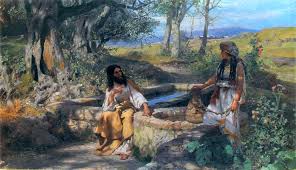
Therefore when the Lord knew that the Pharisees had heard that Jesus was making and baptizing more disciples than John although Jesus Himself was not baptizing, but His disciples were), He left Judea and went away again into Galilee. And He had to pass through Samaria . So He came to a city of Samaria called Sychar, near the parcel of ground that Jacob gave to his son Joseph ; and Jacob’s well was there. So Jesus, being wearied from His journey, was sitting thus by the well. It was about the sixth hour.

There came a woman of Samaria to draw water. Jesus said to her, “Give Me a drink.” For His disciples had gone away into the city to buy food. Therefore the Samaritan woman said to Him, “How is it that You, being a Jew, ask me for a drink since I am a Samaritan woman?” (For Jews have no dealings with Samaritans.) Jesus answered and said to her, “If you knew the gift of God, and who it is who says to you, ‘Give Me a drink,’ you would have asked Him, and He would have given you living water.” She said to Him, “Sir, You have nothing to draw with and the well is deep; where then do You get that living water? “You are not greater than our father Jacob, are You, who gave us the well, and drank of it himself and his sons and his cattle?” Jesus answered and said to her, “Everyone who drinks of this water will thirst again; but whoever drinks of the water that I will give him shall never thirst; but the water that I will give him will become in him a well of water springing up to eternal life.” The woman said to Him, “Sir, give me this water, so I will not be thirsty nor come all the way here to draw.

He said to her, “Go, call your husband and come here.” The woman answered and said, “I have no husband.” Jesus said to her, “You have correctly said, ‘I have no husband’; for you have had five husbands, and the one whom you now have is not your husband; this you have said truly.” The woman said to Him, “Sir, I perceive that You are a prophet. “Our fathers worshiped in this mountain, and you people say that in Jerusalem is the place where men ought to worship.” Jesus said to her, “Woman, believe Me, an hour is coming when neither in this mountain nor in Jerusalem will you worship the Father. “You worship what you do not know; we worship what we know, for salvation is from the Jews. “But an hour is coming, and now is, when the true worshipers will worship the Father in spirit and truth; for such people the Father seeks to be His worshipers. “God is spirit, and those who worship Him must worship in spirit and truth.” The woman said to Him, “I know that Messiah is coming (He who is called Christ); when that One comes, He will declare all things to us.” Jesus said to her, “I who speak to you am He .”

I must say that this chapter in According to John is one of my favorite chapters in the Bible. This is striking account of Jesus saying 'Wait!' to everything to make sure this outcast woman is set free from her bondage.

COMMENTARY
Verses 1-6

In this paragraph we have the sitz em laben of our story. All good stories, as this is no doubt one of the best accounts told by John, involve an intriguing account answering the who, what, why, where and when questions of the event(s). Therefore, this paragraph sets us up with a location and circumstance that will be relevant through this chapter until verse 43 when Jesus departs to Galilee. But on the way from Jerusalem to Galilee major events are to occur that give us insight to Jesus himself and those outside the acceptable fold of Judaism.
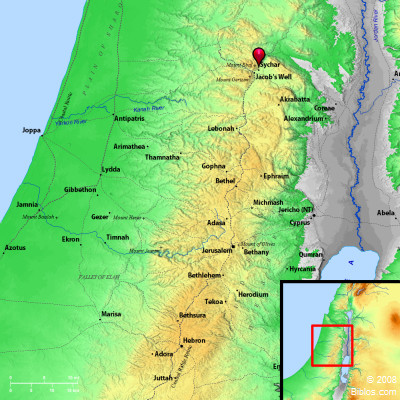
1. Therefore when the Lord knew that the Pharisees had heard that Jesus was making and baptizing more disciples than John 2.(although Jesus Himself was not baptizing, but His disciples were), 3. He left Judea and went away again into Galilee. We are told that it is Jesus intent to leave Judea, in the south, and go to Galilee, in the north. He was making this journey due to increasing notoriety. John, the writer of our gospel, tells us that His baptizing was somehow reaching the Pharisees. Remember, the Pharisees were religious and political rulers and this follows immediately on the heels of Jesus talking with Nicodemus, a pharisee, and John the Baptist clarifying his perspective of Jesus. As a result of the Pharisees viewing Jesus as more potent than John the Baptist and therefore, seeking to deal with Him, this might be the reason John communicates the manner in which Jesus left Judea which is hidden in our English translations. The Greek word for 'left' used in verse 3 is ἀφῆκεν from the root ἀφίημι (aphiêmi)- meaning: to send forth, lay aside, let go, discharge. ἀφῆκεν (aphêken) is in the Aorist Indicative Active 3rd Person, Singular form which implies various meanings of ‘send forth’, in various applications (as follow) -- cry, forgive, forsake, lay aside, leave, let (alone, be, go, have), omit, put (send) away, remit, suffer, yield up. For it is also used in Luke 23:34 and other passages where our English translations use “forgive”. Luke 23:34 "But Jesus was saying, 'Father, forgive them; for they do not know what they are doing.'" It is very well possible that Jesus was leaving Judea and heading to Galilee with forgiveness in his heart. With this deep heart of forgiveness, Jesus 4. had to pass through Samaria. Travel through Samaria was not geographically necessary; the normal route for the Jews was to go around Samaria by crossing the to the east side of the Jordan River (Trans-jordan). Although some take the impersonal verb had to (Ἔδει δὲ) here to indicate logical necessity only, normally in John’s Gospel its use involves God’s will or plan (3:7, 3:14, 3:30, 4:4, 4:20, 4:24, 9:4, 10:16, 12:34, 20:9). “The must or had may be geographical, but I think it has a deeper note. Instead of taking (the trans-jordan road of the Judeans), He chose the road they did not take, as a protest against their reason for not taking it, and a protest against their prejudice and pride. - G. Campbell Morgan, The Gospel According to John, Revell, p. 71." Therefore, given the issues of pride and prejudice (aka a good Jane Austen book and movie) there was a basis for forgiveness being on the heart of Jesus as He departed Judea to go to Galilee through Samaria. 5. So He came to a city of Samaria called Sychar, near the parcel of ground that Jacob gave to his son Joseph; From the Peoples New Testament Commentary comes a good summarization of the history of Sychar: "This place was the ancient Shechem, so famous in the early history. It was forty miles north of Jerusalem, and was situated between Mount Gerizim and Mount Ebal, the Mounts of Blessing and Cursing (Joshua 8:30-35). Here Jacob built his first altar (Genesis 33:18); here Joseph was buried in the land given him by his father (Joshua 24:32); and here also the covenant of Israel was renewed with amens to the blessings and curses, after Joshua had conquered Canaan (Joshua 24:1). It was afterwards called Neapolis, and at present a village called Nablous exists with a population of two thousand, about two hundred of whom are Samaritans and preserve their ancient worship.
"Near to the parcel of ground that Jacob gave to his son Joseph.
In this parcel Joseph was buried when Israel came up out of Egypt, his bones having been carried with them in accordance with his dying wish. His tomb is still shown and it can hardly be doubted that his bones really rest in the place pointed out. - www.biblestudytools.com/commentaries/peoples-new-testament/john/4.html" 6. and Jacob’s well was there. So Jesus, being wearied from His journey, was sitting thus by the well. It was about the sixth hour. Jacob's well is still seen by the traveler, cut through the solid rock, between eight and nine feet in diameter, and about seventy-five feet deep, though partly filled with rubbish - Peoples New Testament Commentary. Jesus is weary from His journey from Judea on His way to Galilee. The sixth hour of the day is referred to 12.00 noon by the majority of the New Testament scholars. Some commentaries, one specifically, The Bible Knowledge Commentary (Edwin A. Blum, Victor Books, p. 285, 1983) promote the Roman time of 6:00 PM in John 4:6. Regardless, the sixth hour is not the time for the gathering of water. If at noon, then according to the Song of Solomon, it is time for the sheep to rest. Jesus is alone for He is at the well at a deserted time of the day.

Verses 7-15
7. There came a woman of Samaria to draw water. Jesus said to her, “Give Me a drink.” There Jesus sits, weary from travel. Along comes a woman and He requests that she give Him a drink. Normal, so far. Physical needs experienced and being met. 8. For His disciples had gone away into the city to buy food. This is an explanation of why Jesus was alone. They were giving attention to another physical need. Also, this heightens the tension of Jesus being alone with the woman even in a public place. They had more social modesty in that time. It was no issue with Jesus being alone, but it was irregular for the woman to be alone. Thereby increasing the opportunity to interact with a man while alone. 9. Therefore the Samaritan woman said to Him, “How is it that You, being a Jew, ask me for a drink since I am a Samaritan woman?” (For Jews have no dealings with Samaritans.) There we have it. This is no ordinary woman. This is a Samaritan woman. Now the distinctions between Jesus and this woman become illumined. She is expressing her amazement that He had no hospitable rite to ask for such a gesture. Observe that she is the one who makes the national, racial and gender distinctions. Jesus did not. Allow me to differentiate between three sets of distinction raised: 1. Nationality (Israel vs Samaria), 2. Racially (Jewish vs. Samaritan), and 3. Gender (man vs. woman). Regarding nationality: The Samaritans were descendants of 2 groups: (a) The remnant of native Israelites who were not deported after the fall of the Northern Kingdom in 722 b.c.; (b) Foreign colonists brought in from Babylonia and Media by the Assyrian conquerors to settle the land with inhabitants who would be loyal to Assyria. The nation of Israel was chosen by YHWH through the patriarchs of Abraham, Isaac and Jacob (aka Israel). Regarding racial overtones: With most of the people of Israel taken away into exile, the Assyrian king brought in foreigners to tend to the land. An Assyrian governor was placed over the territory. Many of the Jews were taken as captives by Assyria and in their place a foreign upper class of people were imported from Babylon, Cuthah, Acca, Harnath and Sepharvaim (2 Kings 12:24). Mixing ethnic populations of captured nations had been instituted by an earlier Assyrian king to diminish chances of rebellion among conquered people. This resulted in the formation of a hybrid race, who came to be the Samaritans. The Samaritans were a mixed breed while the Jews prided themselves to in their attempt to be racially pure. Regarding gender: women were, by today's standards second class citizens. (I question today's so-called standards). Jewish women were protected by many unforeseen social mishaps by obeying the Law of God. Samaritan women by their own mixed gender which reflected a mixed bag of social restraints, had fewer social protections. The question by this woman reveals tension on all these three issues. She was asking Jesus, How can a Samarian Samaritan woman get a drink of water for a Jewish Israelite man? John heightens the racial component by his parenthetical comment. It was this reason that the normal path, from Judea to Galilee, was to go east and cross the Jordan River to bypass Samaria. 10 Jesus answered and said to her, “If you knew the gift of God, and who it is who says to you, ‘Give Me a drink,’ you would have asked Him, and He would have given you living water.” Note carefully that the woman raised the first obstacle in verse 9. Jesus then responds by not addressing the age old issues but changes the direction of the conversation, if you can call it a conversation at this point, to seeing that she needs to know who He is. While Jesus is luring the woman into a deeper issue here, there is a real world difference between well water (or, sometimes, cistern water) and living water. For the most part, well water is stagnant. It is stagnant usually as the result of being collected and easily contaminated. Only deep wells were resistant to such stagnation and contamination. Living water on the other hand is that in a stream, creek, or river. It is flowing. Therefore, it is being continually oxygenated. There was no 'living water' for miles of Sychar. In fact, wells were dug as a result of being a great distance from streams, creeks or rivers. And no well, regardless of its depth, could compare to the quality of ware from a "living water' source. Hence, 11 She said to Him, “Sir, You have nothing to draw with and the well is deep; where then do You get that living water? This is simply an outcast woman's expression of the literal physical water issues. The well is deep for it is a good well. And, there is not a 'living water' source anywhere close. Perceiving that Jesus is out of touch with the water situation, she then argues concerning the validity of this well. It is old, dependable and deep. 12 “You are not greater than our father Jacob, are You, who gave us the well, and drank of it himself and his sons and his cattle?” The woman makes an incredible inquisition. She perceives that Jesus, by making assertions to supply 'living water,' is claiming to be greater than the Patriarch that dug this well. Who is Jacob? How old is this well? Jacob, who later had his name changed to Israel, was the son of Isaac, who was the son of Abraham. This well was old and it was good enough for Jacob. Since Jacob was the originator of this supreme well that has lasted for generations, how can you, as you sit as a foreigner without a water pail, supply water that surpasses this water from old? All of a sudden she is no longer entranced by the gender, racial and social issues. This man claims to be able to supply something beyond that which she was rightfully and perfectly satisfied. 13. Jesus answered and said to her, “Everyone who drinks of this water will thirst again; 14. but whoever drinks of the water that I will give him shall never thirst; but the water that I will give him will become in him a well of water springing up to eternal life.” Jesus takes the opportunity that the woman gives and goes deep into exposing His identity. He first comments on the water drawn from this deep, antiquated, and highly revered well by stating the obvious however revealing manner. This well is for the physical and is limited even in supplying physical needs. If you thirst, drink from this well, but you will be thirsty again. BUT! begins verse 14. Don't ever gloss over this powerful word. This word is noting a contradiction. It is screaming out with directions to the reader to completely demarcate what was previous to what follows. The phrase in the Greek is ὃς δ’ ἂν. It literally reads "whoever, but, ever." English translations smooth out the reading but leave out the potential importance of ἂν . This word is usually left out in translations marked as untranslatable. However the Greeks in the time of John writing this letter used this word to mean: 'he came.' It is a contraction of the root ἐάν which means 'if haply.' When this word or its contraction appears with ὃς as it does in John 4:14, the meaning conveyed is 'whosoever.' Therefore we translate this phrase as 'But whoever, whosoever.' I am sure you now pick up on the repeated nature of the phrase emphasizing inclusiveness of what follows. This first contradiction sets up the difference between the water the well offers and the water that Jesus offers. One is dead and one is living as to quench thirst temporarily or permanently. Now John draws another contradiction with the use of ἀλλὰ which is translated as 'but.' ἀλλὰ can also mean: otherwise, on the other hand, yet, or except. It is from ἄλλος meaning: other or another. The contrast here is between water that permanently quenches thirst to having the source of living water within you. Honestly, Jesus is offering something that will allow the recipient to never know thirst again. This will 'spring up' or 'leap up' to eternal life. The Greek verb ἁλλομένου in verse 14 is Present Middle Participle Genitive Singular Neuter. According the Liddel-Scott-Jones (LSJ) general Greek literature translated this word in the context of living beings but rarely with regard to individuals. However, this word was used to denote parts of the body that twitched, quivered or throbbed. Luke, a physician uses this word in Acts 3:8 and 14:10 to describe healed paralytics who were now walking, leaping around. Regardless of the Greek literature world non-awareness of the individuals ability to ἅλλομαι, Jesus is making such an offering that will allow the individual to permanently have within that which was temporary, external and for the masses. 15. The woman said to Him, “Sir, give me this water, so I will not be thirsty nor come all the way here to draw.” The woman wants this water. But she, like many of us, do not understand all that Jesus is offering. Sure there are basic understandings but much of eternal life is knowing not only what is being offered but who is being offered. She wants the water that will remove her social, racial, religious and gender issues. But she does not see the spiritual consequences of the water from Jesus.

Verses 16-26

16 He said to her, “Go, call your husband and come here.” What? What happened to Jesus the water? Jesus takes her, and us by surprise by prying into her personal life. Somehow, the water He has to offer will affect her, and our, personal lives. And nothing could be more personal than who you are married to. 17 The woman answered and said, “I have no husband.” Okay, maybe a mistake on Jesus part to pry into the marital affairs of this woman. She says that she is not married. Jesus said to her, “You have correctly said, ‘I have no husband’; 18 for you have had five husbands, and the one whom you now have is not your husband; this you have said truly.” This woman attempted to dance around the truth while being technically correct. Ever done that. She was telling the truth while not telling a lie. Jesus knows her personal plight in life. She is on man or husband number six. She apparently has lived with these six men and in Jesus' eyes each one of these men was her husband. Morality transcends the law. It is a commonly accepted premise that you cannot legislate morality. Notice that Jesus does not condemn her. Find yourself with a similar past? Jesus does not condemn you either. Take note of her response. 19 The woman said to Him, “Sir, I perceive that You are a prophet. 20 “Our fathers worshiped in this mountain, and you people say that in Jerusalem is the place where men ought to worship.” Talk about a diversion. She changes the subject from her personal affairs to Jesus' perspective on worship. As worship affects one's personal life or as one's personal life exhibits worship, so the true character of an individual is defined. Worship is the key universal concept. I know, you may not be a religious person, much less a follower of Christ, but, the truth remains, all people worship something or someone. The object of worship may be a sport, a tree, a car, a person, a job, or recreation. Regardless of the level of religiosity, everyone worships something or someone. We all worship. The question of the ages is the object of our worship. Worship, προσκυνεῖν from προσκυνέω means: "worship, to do reverence to". It is from two nouns: pros and a probable derivative of kuon (meaning to kiss, like a dog licking his master's hand); to fawn or crouch to, i.e. (literally or figuratively) prostrate oneself in homage (do reverence to, adore). NAS Exhaustive Concordance of the Bible with Hebrew-Aramaic and Greek Dictionaries, 1981, 1998 by The Lockman Foundation, Lockman.org. It will suffice, at this time, to raise the all encompassing aspect of worship. John will expose us to the examples and exercise of worship later in his gospel account. Wouldn't you like the opportunity to privately speak to Jesus about worship? She did. And she chose to inquire about the question of her time. Where should one worship? The question of where should one worship transcends all religion, regardless of its purity, to this day. Our contemporary questions might be about 'how' rather than 'where.' 21 Jesus said to her, “Woman, believe Me, an hour is coming when neither in this mountain nor in Jerusalem will you worship the Father. 22 “You worship what you do not know; we worship what we know, for salvation is from the Jews. 23 “But an hour is coming, and now is, when the true worshipers will worship the Father in spirit and truth; for such people the Father seeks to be His worshipers. 24 “God is spirit, and those who worship Him must worship in spirit and truth.” Jesus answers the woman's 'where' question by stating that the location of worship will not be an issue in the future. First, Jesus makes it clear that is through Israel and the Jews themselves that worship and salvation was ordained and fashioned for all nations for all eternity. The Jews are immensely important in the Father's plan. In objection to the location issue, Jesus clarifies issues such as: true worshipers (ἀληθινοὶ προσκυνηταὶ; participants), the Father (τῷ πατρὶ; the object, as opposed to those mentioned above), spirit (πνεύματι) and truth (αληθείᾳ). Are you a participant in worshiping the Father in spirit and truth? Or, are you a participant in worshiping something or someone else in flesh and falsehood? We all worship. The main question is "Who do you worship?"25 The woman said to Him, “I know that Messiah is coming (He who is called Christ); when that One comes, He will declare all things to us.” Even this halfbreed Samaritan knew of the One that was to come. Regardless of her twisted perspective involving race, social status, gender, worship, etc. she knew of the promise of the Messiah. Messiah in the Greek is Μεσσίας. It is of Hebrew origin(mashiyach); the Messias (i.e. Mashiach), or Christ. The Hebrew, מָשִׁ֫יחַ , means anointed or Messiah. It is from mashach meaning anointed; usually a consecrated person (as a king, priest, or saint); specifically, the Messiah. She had a lot of knowledge of the Hebrew and Greek promises of an anointed deliverer. She declares that He will declare all things, yet He has already declared much personal and public to her. What else is there to say? 26 Jesus said to her, “I who speak to you am He .” In one of the most beautiful Greek expression, Jesus discloses His being to this half-breed woman. Jesus uses the expression of Himself that will later tick off the religiosity and make men fall on their faces. He says, ἐγὼ εἰμι. Pronounced in English like 'ego' (like the waffle) and 'I-me'. It literally means, "I, I am.' In this expression, Jesus is expressing His deity. This is the same phrase used in the Septuagint (the Greek translation of the Hebrew Old Testament) when the it translates Exodus 3:14 (אֶֽהְיֶ֖ה אֲשֶׁ֣ר אֶֽהְיֶ֑ה) where God is responding to Moses concerning what he shall tell the Israelites who sent him. The Hebrew does a much better job in capturing the eternal essence of YHWH. Literally אֶֽהְיֶ֖ה אֲשֶׁ֣ר אֶֽהְיֶ֑ה means 'I, I am, I aming.' I know, this is bad English grammar but it is good theology. He is the Alpha and the Omega, the Beginning and the End. This is the name, the essence, the deity that Jesus revealed to the woman. And women all over the world and for all time should take great comfort in the fact that Jesus revealed Himself for the first time in this fashion to a woman of questionable character and social status.

SUMMARY
In a passage that has Jesus changing location from the busy city life of Jerusalem to a countryside well in a shunned land, John provides another private conversation but this time, contrary to Nicodemus' encounter at night, it is a woman in the middle of the day. She is alone, but not for long. She is there to gather water, but she is distracted. She has questions, but all her questions fade away as He speaks His Name,
ἐγὼ εἰμι. What compassion. Do you have questions? Well, He will not condemn, but He will reveal Himself to you and fulfill the desire of your soul.

Jesus begins a pattern that will continue to astound his followers and his opponents for ages to come. He goes where He is not supposed to go. He talks with those He is not supposed to talk to. He does what He is not supposed to do. He says what He is not supposed to say. He challenges religion and society without compromising His integrity and purity.

Come to Jesus with your questions and He will not shun and drive you away. In fact, if you genuinely seek Him, even though you don't know what you're talking about, He will reveal Himself to you. He is the great I AM. I simply cannot get over the fact that the first time it is recorded of Jesus saying,
ἐγὼ εἰμι , He is saying it in a very private conversation with a woman. Women, stop looking for your answers in man, after man, after man, after man, after man. Jesus is....... Until you find Him and know who He is, you will never find what you are looking for in men. Seek Him while He may be found.


Let us know at FLSMinistries@bellsouth.net if we can help you.