Showing posts with label I AM. Show all posts

Thursday, August 25, 2011

John 11:1-46 Resurrection Lesson: BELIEF

v.v. 1-16 Jesus with the Disciples
v.v. 17-29 Jesus with Martha
v.v. 30-37 Jesus with Mary
v.v. 38-44 Jesus with Lazarus
v.v. 45-46 Jesus with the 'many' and the 'some'


vv1-16
Now a certain man was sick, Lazarus of Bethany, the village of Mary and her sister Martha. It was the Mary who anointed the Lord with ointment, and wiped His feet with her hair, whose brother Lazarus was sick. As we set up this event that is dear to all those who follow Jesus, our gospel writer, John, brings us exclusively into the arena where the teaching of Jesus is applicable to all of life and death. According to John, which is not purely chronological, Jesus has been beyond the Jordan (east) after the Feast of Dedication. He is in trans Jordan region. Note the pre-event mention of Mary's act of service and worship. John does not tell us, 21st Century readers, about Mary's act until chapter 12, but for some reason, he desires for us to not be mistaken. This is the same girl and the same family. In the midst of complete turmoil with the sickness and death of a loved one, Jesus speaks and teaches His followers regarding the truths that will never be swayed by life's mourning events. Hence, news from Bethany provides an opportunity for the His disciples to learn a valuable lesson. The sisters sent word to Him, saying, “Lord, behold, he whom You love is sick.” Here is the dreaded news that a loved one is sick. The sisters, deep in their grief sent word to Jesus. In appealing to the deepest part of His being, they call upon His love for their brother. For there is no greater motivation than love. But when Jesus heard this, He said, “This sickness is not to end in death, but for the glory of God, so that the Son of God may be glorified by it.” Now Jesus loved Martha and her sister and Lazarus. So when He heard that he was sick, He then stayed two days longer in the place where He was. There appears to be something greater than love. Jesus is, as we should be, longing for and loving the 'glory of God' more than anything else. 'Love' is not the issue questioned here. The foundational object of 'love' is raised. What motivates love or what initiates love? In this text and all of life, the 'glory of God' supersedes 'love'. But when 'love' is expressed simultaneously with the 'glory of God' then 'love' is truly divine. "Love' is selfish, self-serving and prideful if it is sought without prioritizing the Glory of God. Therein is love defined as an outworking of heart bent on glorifying God while caring for others. Do you love someone? Then, how is God being glorified in that 'love' relationship? Jesus is glorifying God by not rushing to Bethany to cure Lazarus. The disciples are in the midst of learning that 'death' is not meant to be triumphant. And death is defeated when God is glorified and when the Son of Man (Jesus) is glorified: valuable lesson. Then after this He said to the disciples, “Let us go to Judea again.” Judea represented the southern part of Israel that included Jerusalem and Bethany. It was in that region that Jesus was intensely opposed by the religious hierarchy. This is the last time Jesus would venture there. The disciples said to Him, “Rabbi, the Jews were just now seeking to stone You, and are You going there again?” By asking this question, the disciples articulate that they have not yet learned the 'valuable lesson.' They were naively attempting to look out for His best interest. His best interest, however, is the glory of God and all else submits to that. Jesus answered, “Are there not twelve hours in the day? If anyone walks in the day, he does not stumble, because he sees the light of this world. “But if anyone walks in the night, he stumbles, because the light is not in him.” "In one sense He was speaking of walking (living) in physical light or darkness. In the spiritual realm when one lives by the will of God he is safe. Living in the realm of evil is dangerous. As long as He followed God's plan, no harm would come till the appointed time. Applied to people then, they should have responded to Jesus while He was in the world as the Light (cf. 1:4-7; 3:19; 8:12; 9:5). Soon He would be gone and so would this unique opportunity (Blum, Edwin A., The Bible Knowledge Commentary, New Testament, ed. Walvoord and Zuck, 1983, p. 313)." This He said, and after that He said to them, “Our friend Lazarus has fallen asleep; but I go, so that I may awaken him out of sleep.”For Jesus, death is just like sleep. The disciples then said to Him, “Lord, if he has fallen asleep, he will recover.”This is a classic case of a failure to communicate. Jesus was saying one thing and the disciples were thinking another. Communication, knowing what someone is saying, is paramount in relationships. There lack of understanding accentuates their need to learn this 'valuable lesson.' Now Jesus had spoken of his death, but they thought that He was speaking of literal sleep. So Jesus then said to them plainly, “Lazarus is dead, and I am glad for your sakes that I was not there, so that you may believe; but let us go to him.” Jesus clears the air. He speaks plainly so as to leave no doubt by saying, "Lazarus is dead." Lazarus' death is 'so that you may believe.' Believe what? This is a valuable lesson for His disciples! Jesus has much purposeful joy (χαίρω δι’ ὑμᾶς ἵνα πιστεύσητε) in knowing that they will learn this lesson which will culminate in them believing. Believe what? This is the only time in the gospels where Jesus is quoted saying, "I am glad" (χαίρω). Therefore Thomas, who is called Didymus, said to his fellow disciples, “Let us also go, so that we may die with Him.” Oh Thomas, what misplaced and misdirected zeal. He is not the only one of the disciples with such simplistic devotion.

vv17-29
So when Jesus came, He found that he had already been in the tomb four days. Now Bethany was near Jerusalem, about two miles off; and many of the Jews had come to Martha and Mary, to console them concerning their brother. A dead body in the tomb for four days in the hot Palestinian area. It was common in Jewish custom for professional mourners to show up at funerals. The amount of tears, whether sincere or not, was thought to represent the deceased social value. Bethany, being about 2 miles from Jerusalem was able to draw professional mourners from the epic center of Judaism. Their house was soon full of guests when Martha receives some news that penetrates all the crowd chatter. Martha therefore, when she heard that Jesus was coming, went to meet Him, but Mary stayed at the house. Martha then said to Jesus, “Lord, if You had been here, my brother would not have died. “Even now I know that whatever You ask of God, God will give You.” Martha's action and statement here should set everything that the Martha's of this world are know for. She heard and went to Jesus. Mary, on the other hand, heard and stayed at the house. Martha was aggressive and immediately responsive. Mary was somewhat passive and delayed in her response to greet Jesus. Some commentators say that Mary was concerned with being polite to the guest in her house where Martha was looking for any opportunity to bolt from the crowd and Jesus, precious Jesus, was more than legitimate reason to leave. Take note of her comment. It will be repeated by Mary later. Martha, however, articulate her belief in Jesus connection with God. Jesus said to her, “Your brother will rise again.” Was this the answer to the question she did NOT ask when she made the connection with Jesus and God? Or, was it just a common reassurance of comfort and hope? Martha said to Him, “I know that he will rise again in the resurrection on the last day.” Lazarus is dead and has been dead for four days. Surely Jesus is referring to the post death resurrection to judgment on the last day when all deeds will be made bare. Martha's statement reflected a common acceptance in a Pharisaical teaching that there will be a general resurrection of the just (cf Acts 23:6-7). Jesus said to her, “I am the resurrection and the life; he who believes in Me will live even if he dies, and everyone who lives and believes in Me will never die. Do you believe this?” Jesus responds to Martha and her Pharisaical resuscitation with a profound personal revelation. This is one of His uses of the ἐγὼ εἰμι which identified Him with the God of Abraham, Isaac and Jacob: ἐγὼ εἰμι ἡ ἀνάστασις καὶ ἡ ζωή. Do you believe this? This is the question of the age. This is John 3:16 is resurrection terms. HE IS ...... She said to Him, “Yes, Lord; I have believed that You are the Christ, the Son of God, even He who comes into the world.” Great job! She knew Him. She believed this. When she had said this, she went away and called Mary her sister, saying secretly, “The Teacher is here and is calling for you.” Aw, and like so many others who have a personal encounter with the I AM they can't wait to tell someone and this case Martha goes and gets her sister Mary. She went herself and told her sister herself secretly (λάθρᾳ meaning 'secretly or privately." Used in the New Testament 4 times: Matthew 1:19; 2:7; John 11:28 and Acts 16:37). And when she heard it, she got up quickly and was coming to Him. Now it is time for Mary to go to Jesus. She heard and she went. And she responds quickly.

vv30-37
Now Jesus had not yet come into the village, but was still in the place where Martha met Him. Then the Jews who were with her in the house, and consoling her, when they saw that Mary got up quickly and went out, they followed her, supposing that she was going to the tomb to weep there. Jesus rendezvouses with Martha and Mary outside the town for they came to Him while He was coming to them. The crowd, the professional mourners and friends mistake where Mary is going. They followed without knowing where they were going. They assumed the logical and the rational. Therefore, when Mary came where Jesus was, she saw Him, and fell at His feet, saying to Him, “Lord, if You had been here, my brother would not have died.” Mary, as soon as she sees Him, does not say a word before she does what she well known for. She fell at His feet. Then she says what Martha said: "Lord, if You......" When Jesus therefore saw her weeping, and the Jews who came with her also weeping, He was deeply moved in spirit and was troubled, and said, “Where have you laid him?” Jesus is emotionally engaged in their affairs. He is 'deeply moves in spirit' and 'troubled.' HE IS ...... They said to Him, “Lord, come and see.” What a delightful plea. The girls invite Jesus to visit the grave of there brother. 'Come and see' what? The flowers? The inscription on the tombstone? The memorial in the paper? The .........? They had simply devotion and belief. There wasn't much to see, but they wanted Jesus to see it. Jesus wept. Here we have one of the shortest verses in the Bible. So the Jews were saying, “See how He loved him!” But some of them said, “Could not this man, who opened the eyes of the blind man, have kept this man also from dying?”

vv38-44
So Jesus, again being deeply moved within, came to the tomb. Now it was a cave, and a stone was lying against it. Jesus said, “Remove the stone.”John describes for us the continuation of the emotional depth of Jesus regarding the death of a friend and the anguish the sisters. 'Remove the stone' was a very unorthodox instruction. "He desired to convince all those who were at the place, and especially those who took away the stone, that Lazarus was not only dead, but that putrescency had already taken place, that it might not be afterwards said that Lazarus had only fallen into a lethargy; but that the greatness of the miracle might be fully evinced. - Clarke's Bible Commentary, http://clarke.biblecommenter.com/john/11.htm." Martha, the sister of the deceased, said to Him, “Lord, by this time there will be a stench, for he has been dead four days.” She states the facts. Lazarus is thoroughly dead. Jesus said to her, “Did I not say to you that if you believe, you will see the glory of God?” Nice. Jesus reminds her of their conversation moments ago. Evidence and articulation of seeming contrary facts offer ripe opportunities for issues such as 'the glory of God' (ὴν δόξαν τοῦ θεοῦ). So they removed the stone. They obeyed Jesus' unorthodox directive. Then Jesus raised His eyes, and said, “Father, I thank You that You have heard Me. “I knew that You always hear Me; but because of the people standing around I said it, so that they may believe that You sent Me.”John's purpose up to this point in the story is to reveal how Jesus revealed Himself to those close to Him: His disciples, Mary, and Martha. He was emotionally engaged in the physical aspect of death and He used that circumstance to communicate His Deity. From that situation John draws our focus to a short conversation Jesus has with His Father. What stands out here is that Jesus, before anything else, gives thanks to His Father. Then He continues with the purpose of the prayer. All prayer should contain, if not begin, with an expression of gratitude. When He had said these things, He cried out with a loud voice, “Lazarus, come forth.” I like the way some preachers articulate the personalization Jesus applies. For, if He had simply said, 'Come forth,' every dead person would have risen. This personalization is contrasted with the generalized resurrection commonly promoted by the Pharisees which Martha grappled with. The man who had died came forth, bound hand and foot with wrappings, and his face was wrapped around with a cloth. Lazarus was not only dead. He was buried. Jesus said to them, “Unbind him, and let him go.”Lazarus was alive from the dead, resurrected by Jesus, but yet he was still bound. Jesus told others to loose him. We don't know if the 'them' was Martha and Mary or the crowd of Jews that followed Mary from the house. Nevertheless, Jesus did not loose Lazarus from his grave clothes.

vv45-46
Therefore many of the Jews who came to Mary, and saw what He had done, believed in Him. Some believed. But some of them went to the Pharisees and told them the things which Jesus had done. And some believed NOT.

SUMMARY
While being emotionally engaged with the sickness and death of His friend Lazarus, Jesus maintains His focus on revealing His identity while leading His followers to respond with belief. To the disciples He said, "...so that you may believe..." To Martha He said, "Do you believe this?" To Martha again, "Did I not say to you, if you believe....?" To His Father so that all would hear, "... that they may believe ..." Then among the crowd, some 'believed in Him."

APPLICATION

1. Have you seen the glory of God? Would you know what it was if you saw it?
2. Do you believe this?
3. In times of grief and mourning, we must prioritize worship! Then we can articulate our requests and mourning expressions. Give thanks in all things, for this is the will of God concerning you.
4. Are you walking around in your grave clothes? You may be born again, but you are entrapped by the ways of your former life.
5. Are you assisting others by removing their grave clothes? The world is full of Christians 'walking around in their grave clothes.' LOOSE THEM!

Contact Information
Email: flsministries@bellsouth.net
Facebook: Family Life Style Ministries
Twitter: flsministries

Tuesday, August 2, 2011

John 10:1-21 Scene 5

This section is the one of the final scenes in our Act which began Chapter 7. This act of John's Gospel takes place in Jerusalem around the time of the Feast of Booths.

Verses 1-6 The Shepherd and His Sheep

Verses 7-18 "I AM"
Verses 19-21 Father and Son

This scene continues directly from Scene 4 but it can be viewed as a closeup of Jesus' face with outbreaks to sheep, shepherd(s), criminals and sheep folds. Regardless of the ending of Scene 4 with Jesus articulating ones sinful plight, the camera must now follow the subject of Jesus' articulation that describes sheep and shepherds, and His Father and Him. There is a lowering of volume in His voice. He softens His tone and says, “Truly, truly, I say to you, he who does not enter by the door into the fold of the sheep, but climbs up some other way, he is a thief and a robber. “But he who enters by the door is a shepherd of the sheep. “To him the doorkeeper opens, and the sheep hear his voice, and he calls his own sheep by name and leads them out. “When he puts forth all his own, he goes ahead of them, and the sheep follow him because they know his voice. “A stranger they simply will not follow, but will flee from him, because they do not know the voice of strangers.” Notice four relationships in His figure of speech: 1. exclusivity of the legitimate shepherd; 2. uniqueness of the shepherd's voice; 3. knowing each other; and 4. sheep following the shepherd.
  1. The Exclusive Shepherd. I use the term 'exclusive' for sheep only know the voice of their shepherd. His access to them is bold and without pretense. All others must sneak and trick the sheep. The intruding shepherd 'climbs' while the shepherd enters. Those guarding the sheep fold, not shepherding the sheep know the shepherd and let him in for the sheep are His and His alone. Even the doorkeeper is an under-shepherd.
  2. They know His voice. This is the essential element of being a sheep. For knowing the Shepherd's voice sets the path for your very sustenance (food, water, protection). You must know the voice of your shepherd. Do you know the voice of God? Do you know the voice of your Shepherd? Who is the shepherd of your soul?
  3. Knowing each other. Knowing not just His voice, do the sheep know Him, the one who is their shepherd? The Shepherd knows the sheep. He knows their name. He calls each one by name. No, 'Buddy," "Ma'am," "Sir," "Young Man," "Kid," "Hey You," or whistle, whoop, holler or yell. He calls each sheep by name. The naming of sheep was an ancient shepherding practice.
  4. Following the shepherd. They follow Him. Wherever He leads, they go.
These four aspects that characterize the relationship between the Shepherd and His sheep are contrasted by the relationship between all others who are NOT the shepherd of the sheep and the sheep. They sneak up on the sheep. They have strange voices. They do not know their name(s). They cannot lead because the sheep will not follow.
This figure of speech Jesus spoke to them, but they did not understand what those things were which He had been saying to them.They, like many of us in the 21st Century may not understand the figure of what was commonplace in the Middle East. For a shepherd tending his sheep was as common then as oil wells in east Texas, as orange groves in Florida, as peach groves in Georgia, as pig farms in eastern North Carolina. They, the original audience, were far removed from the shepherd lifestyle. During the time of the festivals, as we are in the tail end of the Feast of Booths, the Jewish population journeyed to Jerusalem. This journey was not usually made by the shepherds for sheep always need tending. Sheep tending then can be equated to 'garbage collectors' and 'dairy farmers.' Garbage must be picked up. Dairy cows must be milked. For a good treatment of a shepherd's lifestyle and how God often pictures Himself as a Shepherd, read Phillip Keller's book entitled "A Shepherd Looks at the 23rd Psalm."


So Jesus said to them again, (very simply, as in a calm, yet purposed voice in order to explain) “Truly, truly, I say to you, I AM (emphasized, εγω ειμι) the door of the sheep. “All who came before Me are thieves and robbers, but the sheep did not hear them. “I AM (emphasis, εγω ειμι) the door; if anyone enters through Me, he will be saved, and will go in and out and find pasture. “The thief comes only to steal and kill and destroy; I came that they may have life, and have it abundantly. In this paragraph we have some of the most familiar words of Jesus. Yet, the context of those familiar words are often misunderstood. First, as we flow from the previous paragraph, Jesus is explaining the personal, eternal and practical relevance of the Shepherd and Sheep figure. He contrasts Himself with 'thieves' who come blatantly but under cover to ransack the sheep leaving them dispersed, hurt and killed. He is I AM who distinguishes Him from all the impostors, posers and outright vigilantes that came in His name. He is I AM as it relates to the sheep's access to safe haven, both initially, routinely and perpetually. To the uttermost purpose of the thief (steal, kill and destroy), I AM purposes to provide giving and receiving, create and give birth, and improve, repair and restore. We 'go in and go out and find pasture.'

I AM (emphasized, εγω ειμι) the good shepherd; the good shepherd lays down His life for the sheep. Now, we have a distinguishing characteristic of a true shepherd.“He who is a hired hand, and not a shepherd, who is not the owner of the sheep, sees the wolf coming, and leaves the sheep and flees, and the wolf snatches them and scatters them.He flees because he is a hired hand and is not concerned about the sheep. Jesus is now contrasting Himself with one who is paid for his services to the sheep: hired hand. The hired hand is not the owner. He scatters with the sheep when danger comes. He is as much concerned for himself than he is for the sheep. A hired hand has the authority to protect the sheep but finds himself acting just like a sheep. The Good Shepherd is not a hired hand. HE owns the sheep. The sheep are HIS. HE does not flee but battles with the predators of HIS sheep. HE is more concerned for the sheep than HE is for HIMSELF. This issue is further developed. "I AM (emphasized, εγω ειμι) the good shepherd, and I know My own and My own know Me, even as the Father knows Me and I know the Father; and I lay down My life for the sheep. As we reflect on the four characteristics of a shepherd from above, the issue of 'knowing' is the most important characteristic. And Him knowing us is only understood when related to the 'knowing' that the Father has of Him and that He has of the Father. The Good Shepherd knows the sheep, not as the world may define the knowledge, but as only God, the Father and the Son, can illustrate. The world, in and of itself, does not and can not comprehend this 'knowing.' Upon this deep relational element between the Father and the Son and with all of its authority, Jesus makes a revolutionary statement: “I have other sheep, which are not of this fold; I must bring them also, and they will hear My voice; and they will become one flock with one shepherd. Here we have one of the most direct statements of Jesus regarding the inclusion of Gentiles under His mission. This picture would be understood by all hearing it. The issue of foreign sheep being mixed with the original sheep does not seem to challenge most Palestinian shepherds. Once there is a relationship (voice, name, etc.) sheep pay more attention to the shepherd than they do each other. “For this reason the Father loves Me, Jesus not only knows that His Father loves Him, but He knows why! Why? because I lay down My life so that I may take it again. The reason the Father loves Jesus the Son is because He is going to fulfill the primary heart objective of His Father. He is going to reconciled, redeem, ransom, reclaim that which was lost. There is no resurrection without the death of Jesus. “No one has taken it away from Me, but I lay it down on My own initiative. I have authority to lay it down, and I have authority to take it up again. Be it very clear. The issue of Jesus being betrayed, arrested, tortured, crucified, rejected and killed, is not solely the acts of men. All that happened, future in this Gospel account, supremely by the authority of the Lord Jesus Christ. This commandment I received from My Father.”Even Jesus is under the authority of His Father. He was given a commandment and has the authority to obey it (or, not) but He will choose to completely obey thereby being our example in so many ways.

A word from the narrator which serves to close the act. The focus pulls away from Jesus speaking to those who are close by. The camera shows while the narrator tells that A division occurred again among the Jews because of these words. Again, a division. Many of them were saying, “He has a demon and is insane. Why do you listen to Him?” Others were saying, “These are not the sayings of one demon-possessed. A demon cannot open the eyes of the blind, can he?”Here we have a striking commentary on the mentally of the crowd. They, both 'many of them' and 'others,' were more well versed in the ways of demonology than they were in the ways of God. They knew enough of the powers, purposes and presence of demons to comment both positively and negatively as they attributed the works of Jesus to demons.


APPLICATION

  1. Do you know His voice? How does He speak to you? He speaks to me most clearly when He speaks 'conviction' (you sinned, you lied) when my being is being bombarded with 'condemnation' (you are a sinner, you are a liar).
  2. Do you know that God loves you? Do you know 'why' He loves you?
  3. Fathers, do your children know that you love them? Do they know 'why' you love them?
  4. Who do you say He is? Liar, Lunatic or Lord?
  5. In the light of necessity of sheep to know and to be known as it regards the shepherd and regarding the fine tuning of our hearing to ascertain His voice, is there any room to educate and know and mimic and entertain the ways of demons? Woe to the sheep who know the ways of demons, sorcerers, and witchcraft more than, perhaps to the negation of the voice of the Good Shepherd.

CONTACT US
Family Life Style Ministries, Inc.
Email: flsministries@bellsouth.net
Facebook: Family Life Style Ministries, Inc.
Twitter: flsministries

Thursday, December 23, 2010

John 7:37-52 Still Thirsty at the End of the Party?

Paragraphs
Verses 37-44 Jesus' Words Split the Crowd
Verses 45-52 Religious Fallout

COMMENTARY

Verses 37-44
v. 37 Now on the last day, the great day of the feast,
Jesus stood and cried out, saying, "If any man is thirsty, let him come to Me and drink. The Festival of Booths was primarily a festival of celebration with Yom Kippur being a festival of fasting and resting. The last day of the Festival of Booths or Tabernacles was the greatest day, the climax, the most important day, and/or the great day of festivity. Thirsty (διψᾷ)? Then come (ρχέσθω) and drink (πινέτω). If you are not thirsty, then do not come. If you are thirsty, then come. If you come, then drink. How rare it is to encounter someone at a party or festival that does not have something to drink in their hand or near by. I know, at a party, alcohol or strong caffeinated drinks are usually available at the bar. But Jesus, and what He brings, supersedes any kind of argument related to the substance of thirst quenching beverages. v. 38 "He who believes in Me, as the Scripture said, 'From his innermost being shall flow rivers of living waters.'" The Greek word, τῆς κοιλίας, translated 'innermost being' means: belly, womb, inner man, heart, stomach, abdomen. Which of these meanings will be clarified as we read further. v. 39 But this He spoke of the Spirit, whom those who believed in Him were to receive; for the Spirit was not yet given, because Jesus was not yet glorified. At the end of this Festival of Booths in which there was much opportunity to quench thirst, Jesus declares Himself to be the source of renewable, not stagnant like a well, beverage. The Spirit, the third person of the Trinity, is soon to be given and will always be fresh while convicting, renewing, prompting, guiding, and declaring. The Apostle Paul, in his letter to the Ephesians (5:18), was applying this Gospel passage in stating: "Do not get drunk on wine, which leads to debauchery. Instead, be filled with the Spirit." The Greek word, ἐδοξάσθη, translated 'glorified' means: to properly ascribe weight by recognizing real substance, to magnify, extol, held in honor, to distinguish. The following responses to Jesus' words fulfill Paul's writing in Letter to the Romans (1:18-23). 'Glory', which is closely related to 'worship,' is a huge issue when making conscious decisions. Below we have a myriad of responses. v. 40 Some of the multitude therefore, when they heard these words, were saying, "This certainly is the Prophet." v. 40. Others were saying, "This is the Christ." Still others were saying, "Surely the Christ is not going to come from Galilee, is He? v. 42 "Has not the Scripture said that the Christ comes from the offspring of David, and from Bethlehem, the village where David was?" v. 43 So there arose a division in the multitude because of Him. v. 44. And some of them wanted to seize Him, but no one laid hands on Him. 1. Some of the multitude: Identified the Prophet. 2. Others: Identified the Christ. 3. Still others: Express their Biblical and Prophetical knowledge. We three clearly defined groups with three differing expressions. What's up with the distinction and how does that led to 'some of them' wanting to 'seize Him?' There is a difference between being the Prophet (ὁ προφήτης), the Christ (ὁ χριστός) and fulfilling origin prophecies. Luke addresses their paternal lineage question in Luke 2:1-7 (The Nativity Story).

Verses 45-52
v. 45 The officers therefore came to the chief priests and Pharisees, and they said to them, "Why did you not bring Him?" Remember the officers? They were sent by the chief priests and Pharisees to seize Jesus (v. 32). The officers returned to the senders empty handed. They did not carry out the arrest warrant. They failed and they are asked 'why.' v. 46 The officers answered, "Never did a man speak the way this man speaks." They answered commenting on Jesus' authority expressed in the way He spoke. What did they hear? First, since being sent by the chief priests and Pharisees, they heard Jesus comment on His coming and going which no one will know about. Second, they heard Jesus address His ability to quench thirst that no party or festival beverage can quench. He will provide living water. That was their answer to the chief priests and Pharisees. v. 47 The Pharisees therefore answered the, "You have not also been led astray, have you? v. 48 "None of the rulers or Pharisees has believed in Him, has he? v. 49 "But this multitude which does not know the Law is accursed." The Pharisees are who are experts at being led astray, not believing and not knowing the Law, reveal their character. The Pharisees: "were the most respected and influential group in Judaism. Having originated about 135 B.C., they were committed fellowship of men, determined to follow in exact detail everything required in the Mosaic Law. ... But the Pharisees made a tragic mistake. It began with their scribes (the experts in Bible interpretation) constantly interpreting and reinterpreting the Mosaic Law to show how it might apply to every aspect of contemporary life. To the Pharisee, these interpretations and additions were the oral Torah (law), which they place beside the written Torah as having equal authority." - Expository Dictionary of Bible Words, Lawrence O. Richards, Zondervan, p. 484-485, 1985. They, themselves, were lead astray from the Law. v. 50 Nicodemus said to them (he who came to Him before being one of them), v. 51 "Our Law does not judge a man, unless it first hears from him and knows what he is doing, does it?" Remember Nic from John Chapter Three? There he was identified by John as a 'ruler of the Jews.' He was part of the religious ruling party. They claimed to have all religious authority as they ruled the behaviors of the people. Nicodemus, a changed man, argues for Jesus to be able to defend Himself. With this then the Pharisees, who have not heard these words for themselves, as the officers had, might ascribe authority to Jesus' teachings. v. 52 They answered and said to him, "You are not also from Galilee, are you? Search, and see that no prophet arises out of Galilee." They are intimidated and threatened. Therefore they shift the focus. They address Nic's origins. They resort to their previous defense of Galilee being the undesired origin of anything godly (cf. John 6:42; 7:41). They are convinced that their knowledge of the Law (both Torahs) is supreme to anything that Jesus may say.

SUMMARY
Relationships! It amazes me how often societies find themselves gathering at places of beverage consumption. Star Bucks is a high powered the coffee house by developing a following (a tribe) of young people in selling them overpriced coffee. Bars and clubs never survive where alcohol is not permitted to be sold. Beverage and the 'art' of drinking attracts people with a relational need. Therefore, Jesus said, if you are thirsty, come to me. You will never thirst again. Does having your basic and all defining need met in Jesus make you nervous about having your thirst forever quenched: no more drunkenness? Honestly, do I trust Him to begin my day? Do you trust Him to relax you, unwind you, take the edge off, or remove you from the stress of life? Are your relationships defined by what you drink? or, who you trust?

Bible Study
Without the Spirit of God, my Bible study is nothing but an exercise in knowing history. With the Spirit of God (living waters), my Bible study produces revelation of the person and purpose of Almighty God (YHWH, אֶֽהְיֶ֖ה אֲשֶׁ֣ר אֶֽהְיֶ֑ה, I AM, ἐγὼ εἰμι), resulting in a changed me towards the image of His Son, doing the will of the Father.

Romans 1:18-23
For the wrath of God is revealed from heaven against all ungodliness and unrighteousness of men, who suppress the truth in unrighteousness, because that which is known about God is evident within them; for God made it evident to them. For since the creation of the world His invisible attributes, His eternal power and divine nature, have been clearly seen, being understood through what has been made, so that they are without excuse. For even though, they knew God, they did not honor Him as God, or give thanks; but they became futile in their speculations, and their foolish heart was darkened. Professing to be wise, they became fools, and exchanged the glory of the incorruptible God for an image in the form of corruptible man and of birds and four-footed animals and crawling creatures. (Verse 24 Begins with 'Therefore ....")

Family Life Style Ministries, Inc.
E-mail: flsministries@bellsouth.net
Twitter: flsministries
FaceBook: Family Life Style Ministries, Inc.

Saturday, February 6, 2010

John 4:1-26 Samaritan Woman at the Well

According to John
Chapter 4, vv 1-26 (Paragraphs: 1-6; 7-15 and 16-26)

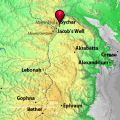
Therefore when the Lord knew that the Pharisees had heard that Jesus was making and baptizing more disciples than John although Jesus Himself was not baptizing, but His disciples were), He left Judea and went away again into Galilee. And He had to pass through Samaria . So He came to a city of Samaria called Sychar, near the parcel of ground that Jacob gave to his son Joseph ; and Jacob’s well was there. So Jesus, being wearied from His journey, was sitting thus by the well. It was about the sixth hour.

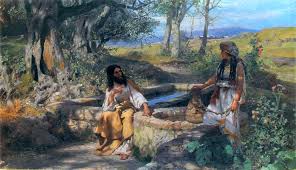
There came a woman of Samaria to draw water. Jesus said to her, “Give Me a drink.” For His disciples had gone away into the city to buy food. Therefore the Samaritan woman said to Him, “How is it that You, being a Jew, ask me for a drink since I am a Samaritan woman?” (For Jews have no dealings with Samaritans.) Jesus answered and said to her, “If you knew the gift of God, and who it is who says to you, ‘Give Me a drink,’ you would have asked Him, and He would have given you living water.” She said to Him, “Sir, You have nothing to draw with and the well is deep; where then do You get that living water? “You are not greater than our father Jacob, are You, who gave us the well, and drank of it himself and his sons and his cattle?” Jesus answered and said to her, “Everyone who drinks of this water will thirst again; but whoever drinks of the water that I will give him shall never thirst; but the water that I will give him will become in him a well of water springing up to eternal life.” The woman said to Him, “Sir, give me this water, so I will not be thirsty nor come all the way here to draw.

He said to her, “Go, call your husband and come here.” The woman answered and said, “I have no husband.” Jesus said to her, “You have correctly said, ‘I have no husband’; for you have had five husbands, and the one whom you now have is not your husband; this you have said truly.” The woman said to Him, “Sir, I perceive that You are a prophet. “Our fathers worshiped in this mountain, and you people say that in Jerusalem is the place where men ought to worship.” Jesus said to her, “Woman, believe Me, an hour is coming when neither in this mountain nor in Jerusalem will you worship the Father. “You worship what you do not know; we worship what we know, for salvation is from the Jews. “But an hour is coming, and now is, when the true worshipers will worship the Father in spirit and truth; for such people the Father seeks to be His worshipers. “God is spirit, and those who worship Him must worship in spirit and truth.” The woman said to Him, “I know that Messiah is coming (He who is called Christ); when that One comes, He will declare all things to us.” Jesus said to her, “I who speak to you am He .”

I must say that this chapter in According to John is one of my favorite chapters in the Bible. This is striking account of Jesus saying 'Wait!' to everything to make sure this outcast woman is set free from her bondage.

COMMENTARY
Verses 1-6

In this paragraph we have the sitz em laben of our story. All good stories, as this is no doubt one of the best accounts told by John, involve an intriguing account answering the who, what, why, where and when questions of the event(s). Therefore, this paragraph sets us up with a location and circumstance that will be relevant through this chapter until verse 43 when Jesus departs to Galilee. But on the way from Jerusalem to Galilee major events are to occur that give us insight to Jesus himself and those outside the acceptable fold of Judaism.
1. Therefore when the Lord knew that the Pharisees had heard that Jesus was making and baptizing more disciples than John 2.(although Jesus Himself was not baptizing, but His disciples were), 3. He left Judea and went away again into Galilee. We are told that it is Jesus intent to leave Judea, in the south, and go to Galilee, in the north. He was making this journey due to increasing notoriety. John, the writer of our gospel, tells us that His baptizing was somehow reaching the Pharisees. Remember, the Pharisees were religious and political rulers and this follows immediately on the heels of Jesus talking with Nicodemus, a pharisee, and John the Baptist clarifying his perspective of Jesus. As a result of the Pharisees viewing Jesus as more potent than John the Baptist and therefore, seeking to deal with Him, this might be the reason John communicates the manner in which Jesus left Judea which is hidden in our English translations. The Greek word for 'left' used in verse 3 is ἀφῆκεν from the root ἀφίημι (aphiêmi)- meaning: to send forth, lay aside, let go, discharge. ἀφῆκεν (aphêken) is in the Aorist Indicative Active 3rd Person, Singular form which implies various meanings of ‘send forth’, in various applications (as follow) -- cry, forgive, forsake, lay aside, leave, let (alone, be, go, have), omit, put (send) away, remit, suffer, yield up. For it is also used in Luke 23:34 and other passages where our English translations use “forgive”. Luke 23:34 "But Jesus was saying, 'Father, forgive them; for they do not know what they are doing.'" It is very well possible that Jesus was leaving Judea and heading to Galilee with forgiveness in his heart. With this deep heart of forgiveness, Jesus 4. had to pass through Samaria. Travel through Samaria was not geographically necessary; the normal route for the Jews was to go around Samaria by crossing the to the east side of the Jordan River (Trans-jordan). Although some take the impersonal verb had to (Ἔδει δὲ) here to indicate logical necessity only, normally in John’s Gospel its use involves God’s will or plan (3:7, 3:14, 3:30, 4:4, 4:20, 4:24, 9:4, 10:16, 12:34, 20:9). “The must or had may be geographical, but I think it has a deeper note. Instead of taking (the trans-jordan road of the Judeans), He chose the road they did not take, as a protest against their reason for not taking it, and a protest against their prejudice and pride. - G. Campbell Morgan, The Gospel According to John, Revell, p. 71." Therefore, given the issues of pride and prejudice (aka a good Jane Austen book and movie) there was a basis for forgiveness being on the heart of Jesus as He departed Judea to go to Galilee through Samaria. 5. So He came to a city of Samaria called Sychar, near the parcel of ground that Jacob gave to his son Joseph; From the Peoples New Testament Commentary comes a good summarization of the history of Sychar: "This place was the ancient Shechem, so famous in the early history. It was forty miles north of Jerusalem, and was situated between Mount Gerizim and Mount Ebal, the Mounts of Blessing and Cursing (Joshua 8:30-35). Here Jacob built his first altar (Genesis 33:18); here Joseph was buried in the land given him by his father (Joshua 24:32); and here also the covenant of Israel was renewed with amens to the blessings and curses, after Joshua had conquered Canaan (Joshua 24:1). It was afterwards called Neapolis, and at present a village called Nablous exists with a population of two thousand, about two hundred of whom are Samaritans and preserve their ancient worship.
"Near to the parcel of ground that Jacob gave to his son Joseph.
In this parcel Joseph was buried when Israel came up out of Egypt, his bones having been carried with them in accordance with his dying wish. His tomb is still shown and it can hardly be doubted that his bones really rest in the place pointed out. - www.biblestudytools.com/commentaries/peoples-new-testament/john/4.html" 6. and Jacob’s well was there. So Jesus, being wearied from His journey, was sitting thus by the well. It was about the sixth hour. Jacob's well is still seen by the traveler, cut through the solid rock, between eight and nine feet in diameter, and about seventy-five feet deep, though partly filled with rubbish - Peoples New Testament Commentary. Jesus is weary from His journey from Judea on His way to Galilee. The sixth hour of the day is referred to 12.00 noon by the majority of the New Testament scholars. Some commentaries, one specifically, The Bible Knowledge Commentary (Edwin A. Blum, Victor Books, p. 285, 1983) promote the Roman time of 6:00 PM in John 4:6. Regardless, the sixth hour is not the time for the gathering of water. If at noon, then according to the Song of Solomon, it is time for the sheep to rest. Jesus is alone for He is at the well at a deserted time of the day.

Verses 7-15
7. There came a woman of Samaria to draw water. Jesus said to her, “Give Me a drink.” There Jesus sits, weary from travel. Along comes a woman and He requests that she give Him a drink. Normal, so far. Physical needs experienced and being met. 8. For His disciples had gone away into the city to buy food. This is an explanation of why Jesus was alone. They were giving attention to another physical need. Also, this heightens the tension of Jesus being alone with the woman even in a public place. They had more social modesty in that time. It was no issue with Jesus being alone, but it was irregular for the woman to be alone. Thereby increasing the opportunity to interact with a man while alone. 9. Therefore the Samaritan woman said to Him, “How is it that You, being a Jew, ask me for a drink since I am a Samaritan woman?” (For Jews have no dealings with Samaritans.) There we have it. This is no ordinary woman. This is a Samaritan woman. Now the distinctions between Jesus and this woman become illumined. She is expressing her amazement that He had no hospitable rite to ask for such a gesture. Observe that she is the one who makes the national, racial and gender distinctions. Jesus did not. Allow me to differentiate between three sets of distinction raised: 1. Nationality (Israel vs Samaria), 2. Racially (Jewish vs. Samaritan), and 3. Gender (man vs. woman). Regarding nationality: The Samaritans were descendants of 2 groups: (a) The remnant of native Israelites who were not deported after the fall of the Northern Kingdom in 722 b.c.; (b) Foreign colonists brought in from Babylonia and Media by the Assyrian conquerors to settle the land with inhabitants who would be loyal to Assyria. The nation of Israel was chosen by YHWH through the patriarchs of Abraham, Isaac and Jacob (aka Israel). Regarding racial overtones: With most of the people of Israel taken away into exile, the Assyrian king brought in foreigners to tend to the land. An Assyrian governor was placed over the territory. Many of the Jews were taken as captives by Assyria and in their place a foreign upper class of people were imported from Babylon, Cuthah, Acca, Harnath and Sepharvaim (2 Kings 12:24). Mixing ethnic populations of captured nations had been instituted by an earlier Assyrian king to diminish chances of rebellion among conquered people. This resulted in the formation of a hybrid race, who came to be the Samaritans. The Samaritans were a mixed breed while the Jews prided themselves to in their attempt to be racially pure. Regarding gender: women were, by today's standards second class citizens. (I question today's so-called standards). Jewish women were protected by many unforeseen social mishaps by obeying the Law of God. Samaritan women by their own mixed gender which reflected a mixed bag of social restraints, had fewer social protections. The question by this woman reveals tension on all these three issues. She was asking Jesus, How can a Samarian Samaritan woman get a drink of water for a Jewish Israelite man? John heightens the racial component by his parenthetical comment. It was this reason that the normal path, from Judea to Galilee, was to go east and cross the Jordan River to bypass Samaria. 10 Jesus answered and said to her, “If you knew the gift of God, and who it is who says to you, ‘Give Me a drink,’ you would have asked Him, and He would have given you living water.” Note carefully that the woman raised the first obstacle in verse 9. Jesus then responds by not addressing the age old issues but changes the direction of the conversation, if you can call it a conversation at this point, to seeing that she needs to know who He is. While Jesus is luring the woman into a deeper issue here, there is a real world difference between well water (or, sometimes, cistern water) and living water. For the most part, well water is stagnant. It is stagnant usually as the result of being collected and easily contaminated. Only deep wells were resistant to such stagnation and contamination. Living water on the other hand is that in a stream, creek, or river. It is flowing. Therefore, it is being continually oxygenated. There was no 'living water' for miles of Sychar. In fact, wells were dug as a result of being a great distance from streams, creeks or rivers. And no well, regardless of its depth, could compare to the quality of ware from a "living water' source. Hence, 11 She said to Him, “Sir, You have nothing to draw with and the well is deep; where then do You get that living water? This is simply an outcast woman's expression of the literal physical water issues. The well is deep for it is a good well. And, there is not a 'living water' source anywhere close. Perceiving that Jesus is out of touch with the water situation, she then argues concerning the validity of this well. It is old, dependable and deep. 12 “You are not greater than our father Jacob, are You, who gave us the well, and drank of it himself and his sons and his cattle?” The woman makes an incredible inquisition. She perceives that Jesus, by making assertions to supply 'living water,' is claiming to be greater than the Patriarch that dug this well. Who is Jacob? How old is this well? Jacob, who later had his name changed to Israel, was the son of Isaac, who was the son of Abraham. This well was old and it was good enough for Jacob. Since Jacob was the originator of this supreme well that has lasted for generations, how can you, as you sit as a foreigner without a water pail, supply water that surpasses this water from old? All of a sudden she is no longer entranced by the gender, racial and social issues. This man claims to be able to supply something beyond that which she was rightfully and perfectly satisfied. 13. Jesus answered and said to her, “Everyone who drinks of this water will thirst again; 14. but whoever drinks of the water that I will give him shall never thirst; but the water that I will give him will become in him a well of water springing up to eternal life.” Jesus takes the opportunity that the woman gives and goes deep into exposing His identity. He first comments on the water drawn from this deep, antiquated, and highly revered well by stating the obvious however revealing manner. This well is for the physical and is limited even in supplying physical needs. If you thirst, drink from this well, but you will be thirsty again. BUT! begins verse 14. Don't ever gloss over this powerful word. This word is noting a contradiction. It is screaming out with directions to the reader to completely demarcate what was previous to what follows. The phrase in the Greek is ὃς δ’ ἂν. It literally reads "whoever, but, ever." English translations smooth out the reading but leave out the potential importance of ἂν . This word is usually left out in translations marked as untranslatable. However the Greeks in the time of John writing this letter used this word to mean: 'he came.' It is a contraction of the root ἐάν which means 'if haply.' When this word or its contraction appears with ὃς as it does in John 4:14, the meaning conveyed is 'whosoever.' Therefore we translate this phrase as 'But whoever, whosoever.' I am sure you now pick up on the repeated nature of the phrase emphasizing inclusiveness of what follows. This first contradiction sets up the difference between the water the well offers and the water that Jesus offers. One is dead and one is living as to quench thirst temporarily or permanently. Now John draws another contradiction with the use of ἀλλὰ which is translated as 'but.' ἀλλὰ can also mean: otherwise, on the other hand, yet, or except. It is from ἄλλος meaning: other or another. The contrast here is between water that permanently quenches thirst to having the source of living water within you. Honestly, Jesus is offering something that will allow the recipient to never know thirst again. This will 'spring up' or 'leap up' to eternal life. The Greek verb ἁλλομένου in verse 14 is Present Middle Participle Genitive Singular Neuter. According the Liddel-Scott-Jones (LSJ) general Greek literature translated this word in the context of living beings but rarely with regard to individuals. However, this word was used to denote parts of the body that twitched, quivered or throbbed. Luke, a physician uses this word in Acts 3:8 and 14:10 to describe healed paralytics who were now walking, leaping around. Regardless of the Greek literature world non-awareness of the individuals ability to ἅλλομαι, Jesus is making such an offering that will allow the individual to permanently have within that which was temporary, external and for the masses. 15. The woman said to Him, “Sir, give me this water, so I will not be thirsty nor come all the way here to draw.” The woman wants this water. But she, like many of us, do not understand all that Jesus is offering. Sure there are basic understandings but much of eternal life is knowing not only what is being offered but who is being offered. She wants the water that will remove her social, racial, religious and gender issues. But she does not see the spiritual consequences of the water from Jesus.

Verses 16-26

16 He said to her, “Go, call your husband and come here.” What? What happened to Jesus the water? Jesus takes her, and us by surprise by prying into her personal life. Somehow, the water He has to offer will affect her, and our, personal lives. And nothing could be more personal than who you are married to. 17 The woman answered and said, “I have no husband.” Okay, maybe a mistake on Jesus part to pry into the marital affairs of this woman. She says that she is not married. Jesus said to her, “You have correctly said, ‘I have no husband’; 18 for you have had five husbands, and the one whom you now have is not your husband; this you have said truly.” This woman attempted to dance around the truth while being technically correct. Ever done that. She was telling the truth while not telling a lie. Jesus knows her personal plight in life. She is on man or husband number six. She apparently has lived with these six men and in Jesus' eyes each one of these men was her husband. Morality transcends the law. It is a commonly accepted premise that you cannot legislate morality. Notice that Jesus does not condemn her. Find yourself with a similar past? Jesus does not condemn you either. Take note of her response. 19 The woman said to Him, “Sir, I perceive that You are a prophet. 20 “Our fathers worshiped in this mountain, and you people say that in Jerusalem is the place where men ought to worship.” Talk about a diversion. She changes the subject from her personal affairs to Jesus' perspective on worship. As worship affects one's personal life or as one's personal life exhibits worship, so the true character of an individual is defined. Worship is the key universal concept. I know, you may not be a religious person, much less a follower of Christ, but, the truth remains, all people worship something or someone. The object of worship may be a sport, a tree, a car, a person, a job, or recreation. Regardless of the level of religiosity, everyone worships something or someone. We all worship. The question of the ages is the object of our worship. Worship, προσκυνεῖν from προσκυνέω means: "worship, to do reverence to". It is from two nouns: pros and a probable derivative of kuon (meaning to kiss, like a dog licking his master's hand); to fawn or crouch to, i.e. (literally or figuratively) prostrate oneself in homage (do reverence to, adore). NAS Exhaustive Concordance of the Bible with Hebrew-Aramaic and Greek Dictionaries, 1981, 1998 by The Lockman Foundation, Lockman.org. It will suffice, at this time, to raise the all encompassing aspect of worship. John will expose us to the examples and exercise of worship later in his gospel account. Wouldn't you like the opportunity to privately speak to Jesus about worship? She did. And she chose to inquire about the question of her time. Where should one worship? The question of where should one worship transcends all religion, regardless of its purity, to this day. Our contemporary questions might be about 'how' rather than 'where.' 21 Jesus said to her, “Woman, believe Me, an hour is coming when neither in this mountain nor in Jerusalem will you worship the Father. 22 “You worship what you do not know; we worship what we know, for salvation is from the Jews. 23 “But an hour is coming, and now is, when the true worshipers will worship the Father in spirit and truth; for such people the Father seeks to be His worshipers. 24 “God is spirit, and those who worship Him must worship in spirit and truth.” Jesus answers the woman's 'where' question by stating that the location of worship will not be an issue in the future. First, Jesus makes it clear that is through Israel and the Jews themselves that worship and salvation was ordained and fashioned for all nations for all eternity. The Jews are immensely important in the Father's plan. In objection to the location issue, Jesus clarifies issues such as: true worshipers (ἀληθινοὶ προσκυνηταὶ; participants), the Father (τῷ πατρὶ; the object, as opposed to those mentioned above), spirit (πνεύματι) and truth (αληθείᾳ). Are you a participant in worshiping the Father in spirit and truth? Or, are you a participant in worshiping something or someone else in flesh and falsehood? We all worship. The main question is "Who do you worship?"25 The woman said to Him, “I know that Messiah is coming (He who is called Christ); when that One comes, He will declare all things to us.” Even this halfbreed Samaritan knew of the One that was to come. Regardless of her twisted perspective involving race, social status, gender, worship, etc. she knew of the promise of the Messiah. Messiah in the Greek is Μεσσίας. It is of Hebrew origin(mashiyach); the Messias (i.e. Mashiach), or Christ. The Hebrew, מָשִׁ֫יחַ , means anointed or Messiah. It is from mashach meaning anointed; usually a consecrated person (as a king, priest, or saint); specifically, the Messiah. She had a lot of knowledge of the Hebrew and Greek promises of an anointed deliverer. She declares that He will declare all things, yet He has already declared much personal and public to her. What else is there to say? 26 Jesus said to her, “I who speak to you am He .” In one of the most beautiful Greek expression, Jesus discloses His being to this half-breed woman. Jesus uses the expression of Himself that will later tick off the religiosity and make men fall on their faces. He says, ἐγὼ εἰμι. Pronounced in English like 'ego' (like the waffle) and 'I-me'. It literally means, "I, I am.' In this expression, Jesus is expressing His deity. This is the same phrase used in the Septuagint (the Greek translation of the Hebrew Old Testament) when the it translates Exodus 3:14 (אֶֽהְיֶ֖ה אֲשֶׁ֣ר אֶֽהְיֶ֑ה) where God is responding to Moses concerning what he shall tell the Israelites who sent him. The Hebrew does a much better job in capturing the eternal essence of YHWH. Literally אֶֽהְיֶ֖ה אֲשֶׁ֣ר אֶֽהְיֶ֑ה means 'I, I am, I aming.' I know, this is bad English grammar but it is good theology. He is the Alpha and the Omega, the Beginning and the End. This is the name, the essence, the deity that Jesus revealed to the woman. And women all over the world and for all time should take great comfort in the fact that Jesus revealed Himself for the first time in this fashion to a woman of questionable character and social status.

SUMMARY
In a passage that has Jesus changing location from the busy city life of Jerusalem to a countryside well in a shunned land, John provides another private conversation but this time, contrary to Nicodemus' encounter at night, it is a woman in the middle of the day. She is alone, but not for long. She is there to gather water, but she is distracted. She has questions, but all her questions fade away as He speaks His Name,
ἐγὼ εἰμι. What compassion. Do you have questions? Well, He will not condemn, but He will reveal Himself to you and fulfill the desire of your soul.

Jesus begins a pattern that will continue to astound his followers and his opponents for ages to come. He goes where He is not supposed to go. He talks with those He is not supposed to talk to. He does what He is not supposed to do. He says what He is not supposed to say. He challenges religion and society without compromising His integrity and purity.

Come to Jesus with your questions and He will not shun and drive you away. In fact, if you genuinely seek Him, even though you don't know what you're talking about, He will reveal Himself to you. He is the great I AM. I simply cannot get over the fact that the first time it is recorded of Jesus saying,
ἐγὼ εἰμι , He is saying it in a very private conversation with a woman. Women, stop looking for your answers in man, after man, after man, after man, after man. Jesus is....... Until you find Him and know who He is, you will never find what you are looking for in men. Seek Him while He may be found.


Let us know at FLSMinistries@bellsouth.net if we can help you.