Tuesday, June 8, 2010

John 5:19-47 Religion vs. Relationship

John 5:19-47
Therefore Jesus answered and was saying to them,
“Truly, truly, I say to you, the Son can do nothing of Himself, unless it is something He sees the Father doing; for whatever the Father does, these things the Son also does in like manner. “For the Father loves the Son, and shows Him all things that He Himself is doing; and the Father will show Him greater works than these, so that you will marvel. “For just as the Father raises the dead and gives them life, even so the Son also gives life to whom He wishes. “For not even the Father judges anyone, but He has given all judgment to the Son, so that all will honor the Son even as they honor the Father. He who does not honor the Son does not honor the Father who sent Him. “Truly, truly, I say to you, he who hears My word, and believes Him who sent Me, has eternal life, and does not come into judgment, but has passed out of death into life. “Truly, truly, I say to you, an hour is coming and now is, when the dead will hear the voice of the Son of God, and those who hear will live. “For just as the Father has life in Himself, even so He gave to the Son also to have life in Himself; and He gave Him authority to execute judgment, because He is the
Son of Man. "Do not marvel at this; for an hour is coming, in which all who are in the tombs will hear His voice, and will come forth; those who did the good deeds to a resurrection of life, those who committed the evil deeds to a resurrection of judgment.
“I can do nothing on My own initiative. As I hear, I judge; and My judgment is just, because I do not seek My own will, but the will of Him who sent Me.
“If I alone testify about Myself, My testimony is not true. “There is another who testifies of Me, and I know that the testimony which He gives about Me is true. “You have sent to John, and he has testified to the truth. “But the testimony which I receive is not from man, but I say these things so that you may be saved. “He was the lamp that was burning and was shining and you were willing to rejoice for a while in his light.
“But the testimony which I have is greater than the testimony of John; for the works which the Father has given Me to accomplish—the very works that I do—testify about Me, that the Father has sent Me. “And the Father who sent Me, He has testified of Me. You have neither heard His voice at any time nor seen His form. “You do not have His word abiding in you, for you do not believe Him whom He sent. “You search the Scriptures because you think that in them you have eternal life; it is these that testify about Me; and you are unwilling to come to Me so that you may have life.
“I do not receive glory from men; but I know you, that you do not have the love of God in yourselves. “I have come in My Father’s name, and you do not receive Me; if another comes in his own name, you will receive him. “How can you believe, when you receive glory from one another and you do not seek the glory that is from the one and only God?

“Do not think that I will accuse you before the Father; the one who accuses you is Moses, in whom you have set your hope. “For if you believed Moses, you would believe Me, for he wrote about Me. “But if you do not believe his writings, how will you believe My words?”


COMMENTARY
John 5:19-47
The beginning of this section, in According to John, introduces Jesus responding to the Jews that were now seeking all the more to kill... HIM. They, as a result of Him claiming God to be His Father, stepped up the level of intensity from persecution to out right premeditated murder. Jesus, with the ink now fresh on wanted posters, was no longer a pest but a problem and threat to their......... position, power, money, prestige, heritage, national security, etc. Hence, 'Let's kill him.' Be no mistaking, God was at the center of their religious lives but they neglected the most important issue.
19. Therefore Jesus answered and was saying to them This whole section is Jesus speaking. He 'answered' them even though they did NOT ask a question. Let it be noted before we go any further that Jesus, the Son of God, not only answers your questions, He knows what you are questioning even though you are confident of your statement that is not yet a question. That is why the text of this section is overwhelmingly red, which is the pattern of major translations demarcating Jesus speaking. As we look at Chapter 5 as a whole, we note that it has 47 verses. The first 18 verses tell of the multifaceted cast in the situation that brings Jesus to speak of His very personal relationship with His Father. The last 28 verses speak of the divine relationship. “Truly, truly, I say to you, the Son can do nothing of Himself, unless it is something He sees the Father doing; for whatever the Father does, these things the Son also does in like manner. Don't you wish all earthly father/son relations worked out in this manner? Fathers, keep that in mind as we move through this section. Sons, pattern your life-long relation with your earthly father as Jesus did with His heavenly Father.
20. “For the Father loves the Son, and shows Him all things that He Himself is doing; and the Father will show Him greater works than these, so that you will marvel. Interesting to note that one of the primary benefits of the Father loving and involving the Son is that WE may marvel. Yes, this is a relationship to behold. This relationship is a pattern for all Father / Son relationships. The Greek word
θαυμάζητε translated 'marvel' in the New American Standard also depicts respect, honor, marvel, worship, wonder, admire and astonishment. The relationship between the Father and the Son provides an illustration that defines the object of our worship. 21. “For just as the Father raises the dead and gives them life, even so the Son also gives life to whom He wishes. Note that the Father raises from the dead. This is key regarding Jesus' resurrection. His Father called Him forth. The resurrection of Jesus Christ will soon be regarded as the ultimate approval of His Father for the redemption of sin. Jesus is about the business of life and He has the authority or permission to bestow life on whoever He wishes. 22. “For not even the Father judges anyone, but He has given all judgment to the Son, 23. so that all will honor the Son even as they honor the Father. He who does not honor the Son does not honor the Father who sent Him. When you step into a contemporary courtroom, this issue is brought out. The one who is 'honored' is the one who 'judges.' When we address 'your honor' in our courtrooms, we are addressing the judge. Therefore, the Son is the one who judges and is to be honored. His position of honor, however, was given to him by his Father. The Greek word τιμάω translated 'honor' in its various forms in this sentence means "to fix the value or to price." It also means "estimate, value, or esteem." This word is rarely used in the context of an 'award' as something 'to give as an honor.' The issue here is honor. What or who do you honor, or place a high price? 24. “Truly, truly, I say to you, he who hears My word, and believes Him who sent Me, has eternal life, and does not come into judgment, but has passed out of death into life. This is an echo of John 3:16-17. The Son has the authority to proclaim in word, grant eternal life, provide escape from judgment, pull out of death and bring into life. Do you hear? And, to what are you listening? Do you believe? Who do you believe? You have this life (maybe) but do you have the next? Are facing judgment? Or, do you have a personal escort into the courtroom who is also the Judge Himself? Does your life depict death or life? Has there been a "passing" in your life? The Greek word means: to pass from one state of being to another. This is much like passing from North Carolina into South Carolina on the way to Atlanta, Georgia. It is like passing from one subject to another when writing or speaking. The Greeks also frequently attached a nuance of pursuing eagerly to the as you go passing. When you pass from death, there is a leaving of death. When you are now in LIFE, you are forever in LIFE. The Apostle Paul said it this way in his letter to the Colossians (1:13-14) "For He rescued us from the domain of darkness and transferred us to the kingdom of His dear Son, in whom we have redemption, the forgiveness of sins." What have you left? Or, have you just added religion to your present state? Jesus calls you to relocate. 25. “Truly, truly, I say to you, an hour is coming and now is, when the dead will hear the voice of the Son of God, and those who hear will live. 26. “For just as the Father has life in Himself, even so He gave to the Son also to have life in Himself; 27. and He gave Him authority to execute judgment, because He is the Son of Man. Did you catch that authority transfer? The authority to judge is once again articulated to be with the Son. You think that the Old Testament is rough as God judges the enemies of Israel, Israel itself and then Judah? The Son has the authority to execute judgment. The Greek word translated 'execute' means to separate, decide, distinguish, choose, elect, trial or interpret judgment. In the Son we now know the intent and perpetuation of judgment. Apart from the Son there is no understanding or experience of judgment. Why? For in the Son is the antithesis of judgment: LIFE. 28. “Do not marvel at this; for an hour is coming, in which all who are in the tombs will hear His voice, 29. and will come forth; those who did the good deeds to a resurrection of life, those who committed the evil deeds to a resurrection of judgment. Do NOT marvel. Why? We must look to the previous sentence for our immediate answer. For we were previously told in verse 20, that we are to marvel in that the Father shows the Son great works that He is doing and greater works that He, the Son, will do. Here, in verse 28 we are abruptly halted in our growing approval of Jesus to make sure that our homage is clearly defined. In all that follows verse 20 with its call to marvel, somehow, the hearing of the Father's voice and the resurrection of all either to life or to judgment is to supersede that.
30. “I can do nothing on My own initiative. As I hear, I judge; and My judgment is just, because I do not seek My own will, but the will of Him who sent Me. Isn't this great. The only begotten Son, who has been given the authority to judge, is humbly noting that He, Himself owes all that He is to His Father. All that He seeks is in total agreement with His Father. This is the model of all father/son relationships. This was the design, but sin twists and kills its intent and our hope. 31. “If I alone testify about Myself, My testimony is not true. Even though Jesus will one day soon return to His position at the right hand of His Father, he knows and makes sure that we know that this is not about Himself. This is from and about His Father. This is about the Father's kingdom and the Father's reputation. This is the Father's testimony and Jesus tells of His transfer of authority. It is not that Jesus says this about Himself, it is that His Father says this about Him. Therefore all Christians should follow Jesus' example for the basis of their being. It is not what we say about ourselves, it is what our Father says about us that is true regardless of how confident or abased we find ourselves. 32. “There is another who testifies of Me, and I know that the testimony which He gives about Me is true. 33. “You have sent to John, and he has testified to the truth. 34. “But the testimony which I receive is not from man, but I say these things so that you may be saved. 35. “He was the lamp that was burning and was shining and you were willing to rejoice for a while in his light. Jesus, having a very dear and high regard for John (the Baptist), is making sure that He validates John's ministry while qualifying its purpose. John (the Baptist) was sent to be a light shining in the wilderness, and to make a way for the coming of Jesus, the Light (According to John 1:6-8).
36. “But the testimony which I have is greater than the testimony of John; for the works which the Father has given Me to accomplish—the very works that I do—testify about Me, that the Father has sent Me. 37. “And the Father who sent Me, He has testified of Me. You have neither heard His voice at any time nor seen His form. 38. “You do not have His word abiding in you, for you do not believe Him whom He sent. In this section we have a repeated term: testimony or testified. The Greek adds to the repetitiveness by using the same root,
μαρτυρέω, for our English translation of 'witness.' As a result of proclaiming His Father, Jesus makes a striking statement to those known for their religiosity. They: 1. have never heard God's voice, 2. have never seen God, 3. do not have God's word in them, and 4. do not believe God. No wonder they were looking to kill Jesus. He completely tore down all of their professional and credentialed motives, religious traditions, national and ethnic pride. 39. “You search the Scriptures because you think that in them you have eternal life; it is these that testify about Me; 40. and you are unwilling to come to Me so that you may have life. Jesus further reveals their processes based on their motives in that their professional endeavors, even though well intended, provide barriers and distractions from the truth. Religion is a powerful tool in the hands of Satan, the Devil. Here is his main battleground. Satan will let you be ultra-religious, quoting the Bible from Genesis to Revelation including the Apocrypha, in order to keep you from knowing the Father and the Son. For this is eternal life: knowing God. Not just knowing about Him. 41. “I do not receive glory from men; 42. but I know you, that you do not have the love of God in yourselves. 43. “I have come in My Father’s name, and you do not receive Me; if another comes in his own name, you will receive him. 44. “How can you believe, when you receive glory from one another and you do not seek the glory that is from the one and only God? What is His Father's name? YHWH, the I AM. It is an amazing historical study to understand the role of YHWH in Israel's history. They hold it most dear but they forbid themselves to say it. Here, Jesus uncovers their complete disdain for anyone to speak it or to relate to it. That is Jesus' point. He comes in YHWH but they do not receive Him. Therefore, when we distance ourselves from the Father YHWH, we will set up religious standards of our own which are sub-standards and prideful. Our then idolatrous ways, for they are apart from or beneath God, are self gratifying and always changing. Seek God's glory for it will never change. 45. “Do not think that I will accuse you before the Father; the one who accuses you is Moses, in whom you have set your hope. 46. “For if you believed Moses, you would believe Me, for he wrote about Me. 47. “But if you do not believe his writings, how will you believe My words?” Knowing about God is always subservient to knowing God. You must first know God to fully understand all that you know about God. If you do not know God, then all that you know about God will condemn you. If you know God, thereby know His Son, their is therefore now no condemnation.
SUMMARY

Isn't this a delightful story? Jesus is now a wanted man for claiming His lineage and family heritage and he calmly answers a question that was not asked. My concern for us is that we will quickly condemn those who Jesus addresses. But, we must be careful of our own prideful idolatrous ways. How much of your so-called religious life rests on doing things for God? If I had only done the right thing....? Or, If I had only known what to do...? Or, If I had only...? Or, If I had...? Or, If I...? Or, If....? Or,...? Forget all that. Do you know Him? Jesus is the One that you will give an account. Are you ready? If not, today is the day to cease all religious activity and rest on His redemption, His forgiveness, His righteousness, His restoration. Know Him and His Father.

Tuesday, May 18, 2010

John 5:1-18 The Healer in Action


According to John 5:1-18:
The Healer in Action
1. After these things there was a feast of the Jews, and Jesus went up to Jerusalem. 2. Now there is in Jerusalem by the sheep gate a pool, which is called in Hebrew Bethesda, having five porticoes. 3. In these lay a multitude of those who were sick, blind, lame, and withered, [waiting for the moving of the waters; 4. for an angel of the Lord went down at certain seasons into the pool and stirred up the water; whoever then first, after the stirring up of the water, stepped in was made well from whatever disease with which he was afflicted.] 5. A man was there who had been ill for thirty-eight years. 6. When Jesus saw him lying there, and knew that he had already been a long time in that condition, He said to him, “Do you wish to get well?” 7. The sick man answered Him, “Sir, I have no man to put me into the pool when the water is stirred up, but while I am coming, another steps down before me.” 8. Jesus said to him, “Get up, pick up your pallet and walk.” 9. Immediately the man became well, and picked up his pallet and began to walk.
Now it was the Sabbath on that day. 10. So the Jews were saying to the man who was cured, “It is the Sabbath, and it is not permissible for you to carry your pallet.” 11. But he answered them, “He who made me well was the one who said to me, ‘Pick up your pallet and walk.’” 12. They asked him, “Who is the man who said to you, ‘Pick up your pallet and walk’?” 13. But the man who was healed did not know who it was, for Jesus had slipped away while there was a crowd in that place. 14. Afterward Jesus found him in the temple and said to him, “Behold, you have become well; do not sin anymore, so that nothing worse happens to you.” 15. The man went away, and told the Jews that it was Jesus who had made him well. 16. For this reason the Jews were persecuting Jesus, because He was doing these things on the Sabbath. 17. But He answered them, “My Father is working until now, and I Myself am working.” 18. For this reason therefore the Jews were seeking all the more to kill Him, because He not only was breaking the Sabbath, but also was calling God His own Father, making Himself equal with God.

COMMENTARY
Verses 1-9a
1. After these things there was a feast of the Jews, and Jesus went up to Jerusalem. Once again, Jesus is headed to Jerusalem for the Passover. Remember the Passover is the 'most important Hebrew feast, commemorating their deliverance from Egyptian bondage (Holman Bible Dictionary, 1991, p. 1076)." John records Jesus previously being in Jerusalem on Passover in Chapter 2 of this gospel. Remember that traveling 'up' in the Bible always refers to Jerusalem. It is not necessarily meaning that you travel northward. According to Nestle-Aland Greek-English New Testament, this sentence stands alone separated from Chapter 4:54 and verse 2 of chapter 5. Regardless of its stand alone paragraph stature, it should cause us to pause and reflect on the preceding before proceeding. Chronologically, this is the end of the first year of Jesus' public ministry. As we walk with John through his gospel, we have witnessed Jesus as eternal, compassionate, willing to reveal Himself, working behind the scenes, healing, challenging and forgiving. At this point, Jesus is turning His attention more to the those in Jerusalem and their need for forgiveness and healing. 2. Now there is in Jerusalem by the sheep gate a pool, which is called in Hebrew Bethesda, having five porticoes. This pool was named after the nearby town of Bethesda or Bethsaida. Skeptics doubt the validity of John's gospel and attribute his description to some other who did not have first hand knowledge of the city of Jerusalem. Thereby, lending all location references to the metaphorical or symbolic interpretation, rather than applying their actual literal significance. Then, in the nineteenth century, archaeologists discovered the remains of a pool exactly matching the description in John's Gospel. Once again, it is confirmed that the Bible refers to real people in real places. 3. In these lay a multitude of those who were sick, blind, lame, and withered, [waiting for the moving of the waters; The bracketed section beginning in this verse continuing through verse 4 is not included some translations due to it not being in many minor manuscripts (mss). This, the pool of Bethesda, was a place that attracted the sick wanting to be healed. The questionable text refers to an angelic visitation upon the pool. 4. for an angel of the Lord went down at certain seasons into the pool and stirred up the water; whoever then first, after the stirring up of the water, stepped in was made well from whatever disease with which he was afflicted.] First one in the angelically moved waters was healed. All others, where left to wait until next time. If you were sick, blind, lame and withered, you chances of being the most attentive and most agile were slim. Hence, 5. A man was there who had been ill for thirty-eight years. How long have you been sick? I know that some of you are ill from your birth. Jesus has compassion on you. However, in this account, we are not told that this man was sick from his birth. At this man's point of 38 years being ill I think that we would be well beyond the so-called 'sick and tired' of being 'sick and tired." The Greek word translated 'ill' is τῇ ἀσθενείᾳ meaning weakness, frailty from the root word ἀσθενής meaning 'feebleness (of mind or body); by implication, malady; morally, frailty -- disease, infirmity, sickness, weakness'. The 'ill'-ness is a broader than some commentators limit the 'ill'-ness to paralysis. 6. When Jesus saw him lying there, and knew that he had already been a long time in that condition, He said to him, “Do you wish to get well?” Are you sick? Jesus, the same yesterday, today and tomorrow, asks you that question. He knows you, your illness and how long. He doesn't want to hear about those more than He wants to know, 'Do you wish to get well?' The Greek word for 'wish' denotes a purpose of your will with a reflection on intention. In other words, 'Do you intend or make plans to get well (whole or healthy)?' The man was so ill for so long that he could not make it out of his bed. Ever been in bed for a long time? Upon erecting yourself for the first time, your joints will scream in pain. I had this pain as a 13 year old when trying to walk down the hospital hallway after being on my back for 3 weeks in traction. Remember the old "Willy Wonka and the Chocolate Factory" movie with Gene Wilder? Remember the 'miracle' of Charlie's grandfather getting out of bed for the first time in years? That is the dramatic expression of the affect of sedentariness. The man at the poolside simply could not move quick enough. 7. The sick man answered Him, “Sir, I have no man to put me into the pool when the water is stirred up, but while I am coming, another steps down before me.” A simple 'YES' would have sufficed. But, like many of us, the man reasoned his way away from answering Jesus by giving Him excuses and previous failed methodicalness. Just answer the question! Do you want to be well? When posed with this question, forget all other attempts. For no human medical method stands to the WORD of the Lord. 8. Jesus said to him, “Get up, pick up your pallet and walk.” What?!!? The Greek word here for 'get up' is also translated as 'Wake up.' An Imperative command from the Lord, when obeyed, is like waking up. Darkness becomes Light. Heaviness becomes Light. Bondage becomes Freedom. For you find yourself transferred out of the kingdom of darkness and into the Kin9dom of His dear Son. 9a. Immediately the man became well, and picked up his pallet and began to walk. What can I say that this verse does not make clear?

Verses 9b-18
9b. Now it was the Sabbath on that day. Oh my, here we go. I feel the religious elite coming to question the validity of a long awaited, much needed miracle. Anytime something in the Gospels mentions the Sabbath, you must remember the historical religious significance of this day. It was simple in the beginning. But, it became very legalistic as men abandoned it original intent. For Jesus, the Word made flesh, said that the Sabbath was made for man, not that man was made for the Sabbath (Mark 2:27). 10. So the Jews were saying to the man who was cured, “It is the Sabbath, and it is not permissible for you to carry your pallet.” Naughty, naughty! Exodus 16 lays the foundation for God's Sabbatical instruction to His People. This text finds us in the middle of the wilderness with the nation of Israel needing food just after being delivered from the Egyptians through the Red Sea. YHWH delivered them. Now, YHWH will provide for them. He has some pre-Ten Commandments (given at Mount Sinai in Exodus 20) instructions for His People: (vv. 24-26) "So they saved (the manna) until morning, as Moses commanded, and it did not stink or get maggots in it. “Eat it today,” Moses said, “because today is a Sabbath to the Lord. You will not find any of it on the ground today. Six days you are to gather it, but on the seventh day, the Sabbath, there will not be any” -NIV. Through the years preceding the event of John 5, the Jewish religious leaders added to their interpretation of this seventh day rest. Let it suffice to say that they added to the point where it was not rest if you carried your bed. Therefore, be careful of those with good religious intentions that lead you away from the intent of God's good instructions. There is a difference between religion and Christianity. In fact, I am of the belief that Satan loves, endorses and propagates religion and religious activities. Beware. 11. But he answered them, “He who made me well was the one who said to me, ‘Pick up your pallet and walk.’” Ah, what a refreshing response. the man knew that if he answered their question, he qould foudn guilty. So, he rightfully deflected to the reason he was carrying his bed on the Sabbath. When pinned down by religiosity you may always find rest by directing your interrogators to the One who made you well, made you free, and made you whole. Jesus, you may be sure, can be trusted to reveal the intent of His Father's Law without adding any religiosity. 12. They asked him, “Who is the man who said to you, ‘Pick up your pallet and walk’?” According to John, this is the first time Jesus performed a miracle in Jerusalem. In John 2, we have Him cleansing the Temple of what I see as adulterated worship. Therefore, they simply do not know who said this. Interesting "Who ... SAID..?" rather than "Who made you well?" Religious people are blinded by religiosity when a walking talking miracle is right there before them. 13. But the man who was healed did not know who it was, for Jesus had slipped away while there was a crowd in that place. No pomp and circumstance needed for the One who is ... our Healer. 14. Afterward Jesus found him in the temple and said to him, “Behold, you have become well; do not sin anymore, so that nothing worse happens to you.” Jesus found the man. It is interesting that the man did not find Jesus. This simple truth reflects the basis of Christianity: Jesus finds us. Great response on behalf of the man made well. He is in the temple doing what he has been taught to do. Jesus takes the man one giant leap farther than what was required in the temple. Jesus gives the man an imperative: Sin no more (μηκέτι μάρτανε). Jesus' imperative gives way to the view that this man's sin caused this illness some 38 years ago. Yes, a sinful lifestyle can make one physically ill for a long time. One sin can make one physically ill. Do not sin anymore. 15. The man went away, and told the Jews that it was Jesus who had made him well. Now that the man knows, he cannot help but to answer the questions. The man was not looking to tattle on Jesus. He simply wanted to make sure that the Jews had the answer to their question while figuring that they might welcome a genuine healer. 16. For this reason the Jews were persecuting Jesus, because He was doing these things on the Sabbath. Instead of welcoming him and celebrating His gifted-ness, they sought to 'persecute' Him. The Greek word translated 'persecute' is δίωκον having the meaning of 'pursuit, cause to run, set in quick motion, put to flight. They did not want Him around anymore. 17. But He answered them, “My Father is working until now, and I Myself am working.” 'But' is my favorite Greek word (δ) which denotes a contrast. Whatever was said before is about to be contradicted. Thought patterns are about to be changed. Behaviors are about to be redirected. Beliefs are about to be reborn. Faith is about to be validated. This time the contrast regards how we see Jesus. Apart from using the 'I AM' known throughout John's gospel, Jesus states that if He heals on the Sabbath, then my Father heals on the Sabbath. 18. For this reason therefore the Jews were seeking all the more to kill Him, because He not only was breaking the Sabbath, but also was calling God His own Father, making Himself equal with God. They got they picture. But instead of yielding and experiencing a 'but' moment of belief regeneration, they put a death warrant out on Jesus. This one issue will be the death of Jesus. For He cannot deny His Father. Do you?


SUMMARY

As we leave the first part of Chapter 5, we have the issue of Jesus identity revealed to the Jews in Jerusalem resulting from the healing of man at the Pool of Bethesda. This man who is healed is interrogated regarding a religious law. Jesus, who did not initially reveal himself to the man, finds him and gives him further instruction regarding his life: Do Not Sin Anymore. The Jews up their Jesus alert status from 'persecuting' to 'seeking all the more to kill Him.'

What about you? Is your lifestyle sinful? Are you sick as a result of it. Be healed. Obey the imperatives of Jesus. Do not sin anymore.

The next section of John's gospel deals more with Jesus identity and His relation with His Father.

If you need any help, please do not hesitate to email us at FLSMinistries@bellsouth.net

Sunday, March 14, 2010

John 4:43-54 Royal Official: Healing and Faith


According to John
Chapter 4


Verses 43-45

43 After the two days He went forth from there into Galilee. 44 For Jesus Himself testified that a prophet has no honor in his own country. 45 So when He came to Galilee, the Galileans received Him, having seen all the things that He did in Jerusalem at the feast; for they themselves also went to the feast.

Verses 46-54
46 Therefore He came again to Cana of Galilee where He had made the water wine. And there was a royal official whose son was sick at Capernaum . 47 When he heard that Jesus had come out of Judea into Galilee, he went to Him and was imploring Him to come down and heal his son; for he was at the point of death. 48 So Jesus said to him, “Unless you people see signs and wonders, you simply will not believe.” 49 The royal official said to Him, “Sir, come down before my child dies.” 50 Jesus said to him, “Go; your son lives.” The man believed the word that Jesus spoke to him and started off. 51 As he was now going down, his slaves met him, saying that his son was living. 52 So he inquired of them the hour when he began to get better. Then they said to him, “Yesterday at the seventh hour the fever left him.” 53 So the father knew that it was at that hour in which Jesus said to him, “Your son lives”; and he himself believed and his whole household. 54 This is again a second sign that Jesus performed when He had come out of Judea into Galilee.


COMMENTARY
Verses 43-45
After the two days He went forth from there into Galilee. Remember, Jesus took a detour from the normal Jewish route, to go through Samaria. The accepted clean "non-associative" route led travelers to traverse the Jordan River when traveling from (to) Judea in the south to ( from) Galilee in the north instead of going straight through Samaria. These two days refer to the time spent with the Samaritan woman and those of her Samaritan city. That part of the story is told in the paragraphs immediately before in According to John. For Jesus Himself testified that a prophet has no honor in his own country. John, the Disciple, Apostle and writer of this account, gives us an interesting statement here. John remembers hearing Jesus saying this about Himself. It was more than a Jewish idiom. At its core we have the subject of "honor" introduced like a fly darting across your field of vision. "Honor" as translated in the New American Standard is τιμὴν (timen) in the Greek language. Even though it is not a major issue in this story, I would like to take this time to begin a cultivation of its meaning so we will have a foundation as we continue through John's account. From the root word, , meaning I. worship, esteem, honor, and in pl. honors, such as are accorded to gods or to superiors, or bestowed (whether by gods or men) as a reward for services, 2. honor, dignity, lordship, as the attribute of gods or kings, 3. a dignity, office, magistracy, and in pl., civic honors, 4. present of honor, compliment, offering, e.g. to the gods, II. of things, worth, value, price, 2. valuation, estimate, for purposes of assessment, III. compensation, satisfaction, penalty. The opposite of honor is shame. Honor is to speak well of or to attribute worth to or to place a great price on. Shame is to speak badly against or to attribute uselessness to or to devalue something or someone. Let me ask you a question. Does your speech, the words that come out of your mouth, sound like honor? Do you honor and build people up? Or, do you shame and tear people down? Now! I know I don't have to look far past my family relationship to see how I have to fight to keep honor in my speech. But, do you honor and build YHWH up in your life? Or, do you shame HIM? I think that John remembered Jesus' comment for this reason. We can sometimes allow familiarity to breed dishonor. Familiarity in any realm of life can provide us with the opportunity to abandon our awe which leads to dishonor. Keep that in mind as you study the whole of God's Word and see how His people frequently fail when familiarity attacks the freshness of their fellowship with YHWH. You must never say (for it is never true), "been there, done that" with YHWH. HE IS........... So when He came to Galilee, the Galileans received Him, having seen all the things that He did in Jerusalem at the feast; for they themselves also went to the feast. The Galileans, these are the ones that Jesus said that they did not honor him, yet they searched Him out because of what He did in Jerusalem. More than likely these Galileans took the trans-Jordan trek from Judea instead of following Jesus through Samaria. They were probably asking each other about Jesus, his doings and sayings, as they reached Galilee from their time in Jerusalem. Jesus was the buzz of their conversations and they were looking to be with Him. Yet, a prophet has no honor in his own country. Their receiving Him might have a superficial flavor to it.

Verses 46-54
Therefore He came again to Cana of Galilee where He had made the water wine. Jesus and his followers, our author included, return to the site of Jesus' first miracle. Remember, Jesus performed this miracle at a wedding and his miraculous deed was behind the scenes to save the face of the bridegroom. If anyone ever understands the role of the bridegroom in a wedding, it is Jesus Christ.
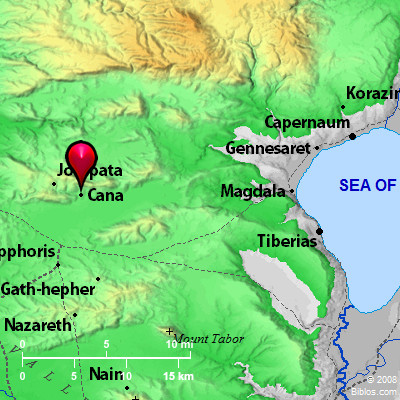
And there was a royal official whose son was sick at Capernaum. It was approximately 25 miles from Cana to Capernaum. Remember that Cana is inland on a slope fit for vineyards. Capernaum was a coastal town on the northwest side of the Sea of Galilee. Regarding the royal official this is no ordinary government bureaucrat. The Greek word here, , tells us and the Greek reading audience that this man was royal, kingly, one who has proven himself truly kingly, and acted with kingly authority. He either belonged to a king, in this case Caesar, or he was the king's friend or officer. He was a little more that noble. John use this term to accentuate this man's tie to royalty so that we see that people from all walks of life came to Jesus for answers and healing. Remember, this falls on the chronological heals of Jesus speaking with the Samaritan woman at the well. The next chronological event, if I may presume, is Jesus speaking with a crippled man. Jesus was known for interacting with all walks of life. Jesus has not changed and He will not change. He can meet you at the point of your need no matter how abased or kingly.
When he heard that Jesus had come out of Judea into Galilee, he went to Him and was imploring Him to come down and heal his son; for he was at the point of death. This royal man heard, went and implored. What an example of someone desperate to have an encounter with Jesus. The word translated heard is the Greek word ἀκούσας is a primary verb meaning to hear (in various senses) -- give (in the) audience (of), come (to the ears), (shall) hear(-er, -ken), be noised, be reported, understand (Strong's Concordance). Have you heard anything concerning Jesus? Then, the royal man went to Him. As a result of hearing about Jesus, the man went to Him. Have acted on your hearing of Jesus by going to Him? Then the royal man was imploring Him. The word translated implore is ἠρώτα from ἐρωτάω meaning to interrogate; by implication, to request -- ask, beseech, desire, entreat, pray. W.E. Vine (Expository Dictionary of N. T. Words, p. 79. Thank you Chris F. for the gift of this book years ago.) states that ἐρωτάω more frequently suggests that the petitioner is on a footing of equality or familiarity with the person whom he requests. It is used of a king in making request from another king.... In this respect it is significant that the Lord Jesus (always used ἐρωτάω) in the matter of making request to the (His) Father." The royal man, with the use of this petitioning word, states his appropriate high view of himself. The man respectfully asked and beseeched Jesus for his son was dying. Death was out of the control of this royal man who desperately dared to put himself on the same footing with Jesus. Are you desperate? If so, then respond to what you have heard, go to Jesus and petition him for life in the areas of death: light in the areas of darkness; peace in the areas of unrest; understanding in the areas of bewilderment; strength in the areas of weakness...
So Jesus said to him, “Unless you people see signs and wonders, you simply will not believe.” The word translated signs is the Greek word σημεῖα meaning a sign from the gods, omen, wonder, portent, as in LXX Exodus 4:8; Matthew 24:24; John 4:48, cf; especially of the constellations, regarded as signs. The Greek word for wonders is τέρατα sign, wonder, marvel, portent, a sign of coming battle; especially of signs in heaven; in concrete sense, monster; of a serpent, of the Sphinx; used by Cicero of Caesar, Att.8.9.4; monstrous birth, monstrosity. The word translated believe is πιστεύσητε in Greek. This word carries much to be investigated regarding its use and meaning, not only to Christian literature but to the whole of Greek literature as it reflects Greek culture. It carries the simply meanings of: trust, put faith in, rely on a person, thing, or statement. Also, certain nuances such as certainty and confidence highlight the central heart felt expression of this royal man. For he said to Him, "Sir, come down before my child dies." A simple request in a time of great need. And Jesus said to him, "Go, your son lives." The word that all parents of dying children would love to hear. The Word in flesh, the great I AM, YHWH, the Lord Jesus Christ speaking to you saying, 'your child lives.' Note the reaction of the child's father. The man believed the word that Jesus spoke to him and started off. There is our believe word again. This time can you feel the confidence that the royal man had in a simple word from Jesus? No questions. No requests to have Jesus repeat what He said. He was sitting on all confidence that expressed his faith. Jesus said it, the man believed it and that settled it. Your son lives. WOW! What faith. What confidence. I only desire to live a life that expresses such simple confidence in Jesus. A faith that does not ask questions nor does it need to understand everything before I accept His Word.
As he was now going down, his slaves met him, saying that his son was living. So he inquired of them the hour when he began to get better. Then they said to him, “Yesterday at the seventh hour the fever left him.” So the father knew that it was at that hour in which Jesus said to him, “Your son lives”; and he himself believed and his whole household. Can you imagine the celebration of life? Do not confuse these slaves situation with their master, the royal man, and the slavery so cruelly forced upon Africans and children in our past and present. New Testament slavery is a subject for interesting study but not at this time. These slaves were trusted with the household while this royal man carried out his duties and visit to see Jesus. They were caring for the son while the father went to beg Jesus to heal his son. Be careful to note the spread of confidence in Jesus throughout this household which more than likely included the slaves. Does your household have a confidence in Jesus? No matter how high socially, politically, economically and scholastically you are, or think you are, there is much to be gained by confidently trusting in Jesus, even for the life of your child.

As he was now going down, his slaves met him, saying that his son was living. So he inquired of them the hour when he began to get better. Then they said to him, “Yesterday at the seventh hour the fever left him.” So the father knew that it was at that hour in which Jesus said to him, “Your son lives”; and he himself believed and his whole household. Can you imagine the celebration of life? Do not confuse these slaves situation with their master, the royal man, and the slavery so cruelly forced upon Africans and children in our past and present. New Testament slavery is a subject for interesting study but not at this time. These slaves were trusted with the household while this royal man carried out his duties and visit to see Jesus. They were caring for the son while the father went to beg Jesus to heal his son. Be careful to note the spread of confidence in Jesus throughout this household which more than likely included the slaves. Does your household have a confidence in Jesus? No matter how high socially, politically, economically and scholastically you are, or think you are, there is much to be gained by confidently trusting in Jesus, even for the life of your child.

This is again a second sign that Jesus performed when He had come out of Judea into Galilee. John's remark here brings us to reflect on Jesus' first miracle in Cana when he turned water into wine at the wedding feast. Both of these miracles were in the private realm with those immediately affected and the disciples. John primarily focuses on the private moments in the life of Jesus. He and his life account are different from the other three gospel writers, Matthew, Mark and Luke.

SUMMARY
This portion of chapter 4 is often overlooked. It stands in the middle of some of the great quoted passage from well known stories from the Bible. Yet, what an example of the authority of Jesus and the confident faith of the high ranking royal man. There is much to be applied from their brief encounter. Act on what you have heard about Jesus. Let those words draw you to him with the aches of your heart. Plead with Him for intervention into your life circumstance(s). Then, accept His word to you, which is a promise of His care for you. If you truly come to Him confidently and then go confidently, then your household will be full of confidence as they trust in Jesus. He is faithful to pull you out of the kingdom of darkness, lies, and death by transferring you into His Kingdom which is the kingdom of light, truth and life.

Need help? Feel free to contact us at FLSMinistries@bellsouth.net