According to John
Chapter 2, Verses 12-25
12. After this He went down to Capernaum, He and His mother and His brothers and His disciples; and they stayed there a few days.
23. Now when He was in Jerusalem at the Passover, during the feast, many believed in His name, observing His signs which He was doing. 24. But Jesus, on His part, was not entrusting Himself to them, for He knew all men, 25. and because He did not need anyone to testify concerning man, for He Himself knew what was in man.
Commentary
Most harmonized or paralleled gospel accounts, putting all four gospels in chronological order, have John 1:19 through 4:42 uninterrupted with other events from Matthew, Mark or Luke.
Verse 12
(As we have verse designations in our translations, the original manuscripts did not contain chapter or verse designations, verse 12 is a paragraph in itself.)
After this He went down to Capernaum, He and His mother and His brothers and His disciples; and they stayed there a few days.
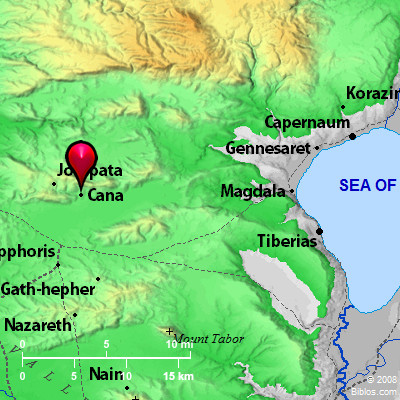
 "Where is Capernaum? : Located on the northwest shore of the Sea of Galilee, Capernaum is a little over 2 miles from the Jordan river. The village was very close to the Via Maris, an important trade route between Syria and Egypt, and evidently levied taxes on caravans passing through. It was 85 miles from Capernaum to Jerusalem. Jerusalem stands on the crest of the Judean hills at an elevation of 2,577 feet above sea-level, 13 miles west of the Dead Sea, 32 miles east of the Mediterranean Sea, and roughly 80 miles south of the Sea of Galilee.
Why is Capernaum important? : Capernaum is important for the study of the New Testament because of its central role in Jesus’ ministry around Galilee. Various miracles, healings, and preaching are described by all four gospel authors as taking place there. Matthew even goes so far as to call Capernaum Jesus’ “own city.” Despite this, Jesus is described as cursing the town because of their rejection of him.
The town is mentioned in the New Testament: in the Luke’s Gospel it was reported to have been the home of the apostles Peter, Andrew, James and John, as well as the tax collector Matthew. In Matthew 4:13 the town was reported to have been the home of Jesus himself. According to Luke 4:31-44, Jesus taught in the synagogue in Capernaum on the sabbath days. In Capernaum also, Jesus allegedly healed a man who had the spirit of an unclean devil and healed a fever in Simon Peter's mother-in-law. According to Matthew 8:5-13, it is also the place where a Roman Centurion asked Jesus to heal his servant.
Verses 13-22
Verse 13
The Passover of the Jews was near, and Jesus went up to Jerusalem. Passover is the most important festival event on the Jewish calendar. It marks Israel's deliverance from Egyptian captivity by the direction and provision of YHWH and the leadership of Moses (Exodus 12). Capernaum was 85 miles from Jerusalem. Jerusalem stands on the crest of the Judean hills at an elevation of 2,577 feet above sea-level, 13 miles west of the Dead Sea, 32 miles east of the Mediterranean Sea, and roughly 80 miles south of the Sea of Galilee. Whenever Jerusalem is the object of one's destination or perspective, it is always "up". Up does not a determining northward direction. Jerusalem may be north, south, east or west of your position but you will always go up to Jerusalem. This is due to its elevation especially when considering its close proximity to the Dead Sea and Jerusalem being some 2500 feet above sea level.
Verses 14-17
14 And He found in the temple those who were selling oxen and sheep and doves, and the money changers seated at their tables. 15 And He made a scourge of cords, and drove them all out of the temple, with the sheep and the oxen; and He poured out the coins of the money changers and overturned their tables; 16 and to those who were selling the doves He said, "Take these things away; stop making My Father's house a place of business." 17 His disciples remembered that it was written, "ZEAL FOR YOUR HOUSE WILL CONSUME ME."
Jesus found two issues in the Temple that stirred His zeal. The challenge here is directly applicable to the modern Church. How do we complicate or over simplify worship of I AM, the Almighty God, YHWH, the ἐγώ εἰμι?
The two issues are animals for sacrifice and moneylenders. The oxen and sheep were animals of the fields. In the Jewish sacrificial system, with no lessening of this Passover occurrence, these animals were to be raised by the families and then presented as a sacrifice. Sheep were the most important sacrificial animal with the ram or the young male often being specified. It was intended for families to raise these animals and bring them to be sacrificed. Passover, however, posed a problem for the worshipers. Some having traveled great distances to Jerusalem for the Passover, Jesus, Himself traveling over 85 miles, found it difficult perhaps even dangerous to bring these blemish-less animals on the pilgrimage to Jerusalem. Ultimately, we have the solution provided by the money changers. The money changers changed money. The exchanged currency so that the pilgrims could purchase the sacrificial ox or sheep that they did not bring themselves. This is worship done easy with the only price being that of potential extortion by the money changers. This is twisted worship. The only thing that the pilgrim needed was to make the trip to the worship center (Jerusalem) and bring money. For everything else will be provided for you. There was no investment on the pilgrim's part. They did not raise the ox or the sheep, they did not make the journey which may have necessitated a trust in God (see Psalm 121, A Song of Assents) and they ended up sacrificing that which they did not know. The issues of the sheep, the oxen and the money changers is that Jesus "drove them out." Why do you think that Jesus only gave a somewhat reserved verbal correction to those selling the doves? A pair of turtle doves, or two young pigeons was an offering sufficient for the poor, specifically for the poor woman that just gave birth (Leviticus 12:8). Therefore, you have the Law's allowance for the poor (mother) but with the overriding command to not make the temple, His Father's House, a place of business. as compared to those who should have brought their own sheep and oxen but did not. They, through a decisive act of their will, relied on the temple sales and the money changers to make their worship easy and less personal.
Worship is always personal and costly. It is simple but not easy. Jesus' zeal was manifested by the easy way in which this Passover was being observed in the Temple. What does He say about our worship, your worship, and my worship of HIM?
Verses 18-22
18. The Jews then said to Him, "What sign do You show us as your authority for doing these things?"
It amazes me that every time someone does or says something bold in contradiction to the norm, correct some deviate behavior, or speak the truth in a mislead company of folks, the issue of authority always rises to the top. The Jews, as we will see, had a foundation questioning of Jesus' authority. Of course, anyone that would upset their nice little religious money making enterprise would definitely be questioned. It is all about authority, control and money. John, this gospel's author, will address 'authority' throughout this gospel account.
19. Jesus answered them, "Destroy this temple, and in three days I will raise it up." 20 The Jews then said, "It took forty-six years to build this temple, and will You raise it up in three days?" 21 But He was speaking of the temple of His body. 22 So when He was raised from the dead, His disciples remembered that He said this; and they believed the Scripture and the word which Jesus had spoken.
What is the authoritative answer to the question regarding authority for the Christian? ...the death, burial and resurrection of the Lord Jesus Christ. It appears by verse 19 that Jesus is foretelling of raising Himself from the dead. He may not desire to instruct about the role of the Father or the Holy Spirit in the resurrection. Irregardless, the life He lived that is characterized by a supreme example of righteousness, would make Him perfectly capable of deserving of resurrection. His righteousness was perfectly accepted before His Father. Therefore, His perfectly righteous condition warranted His resurrection. His resurrection was in His control due to His perfectly righteous standing before His Father. We will learn more of the Father, Son and Holy Spirit relationships as we move through John.
The world, family and work associates may not know of that which you speak, but they will eventually either remember to the point of belief or they will remember when they are forced to bow at the sound of His NAME.
Verses 23-25
23. Now when He was in Jerusalem at the Passover, during the feast, many believed in His name, observing His signs which He was doing. 24. But Jesus, on His part, was not entrusting Himself to them, for He knew all men, 25. and because He did not need anyone to testify concerning man, for He Himself knew what was in man.
It was at this Passover that John tells us that many believed in His name. Their belief came as a result of the signs He did which include His zeal at the temple. When He did the act of over turning that which sets itself against worship, many believed in His name. Worship here can be described as anything that sets itself against a total dependency on God for His protection, His provision and His revelation. Worship is all about HIM.
"But Jesus..." It is amazing that Jesus exhibits a reserved control of His destiny. John will soon tell us to whom He yields. Jesus knows man. If anyone knows you, it is Jesus. Does that bother you? Or, is that comfort to you? Irregardless, creation cannot hide anything from the Creator (see John Chapter One). Man cannot hide anything from Jesus.
Conclusion:
How is your worship? Do you find it easy to pawn off the expense of your religiosity to those who are so-called professionals? Consider your worship experience, even of the Great I AM, are you a spectator or participant? To the degree that you are a spectator by not personally investing or personally participating, your worship is twisted and you will be ultimately driven out of His presence. It has the form of godliness but not the heart of righteousness. Only righteous will stand before and please God. Our righteousness is in Christ for He alone is our Righteousness. Finally, what does the "almightiness" of our God do to you? His is mighty to save. Turn to Him, for in Him is peace.